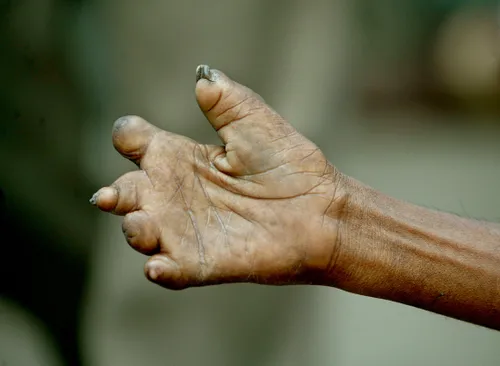
Leprosy. Hansen’s disease. The Big L. The OG outcast illness.
For thousands of years, it was the disease that got you exiled from society, marked as cursed by God, and forced to ring a bell so people could avoid you. It rotted your flesh, took your fingers and toes, collapsed your nose, and made you a living symbol of divine punishment.

Then we cured it in the 1940s.
And… nobody really noticed.
Today, 200,000+ people are diagnosed with leprosy every year. It’s completely curable with a six-month course of antibiotics. You’re probably not going to catch it (95% of humans are naturally immune). And yet the stigma remains so intense that we had to rename it “Hansen’s disease” just to get people to stop freaking out.
So what the hell is leprosy? Where did it come from? Can you actually get it from touching someone? Why did we name it after a Norwegian doctor? And will leprosy ever get its Magic Johnson moment—where someone famous makes it cool and acceptable?
Let’s find out.
What Is Leprosy? (The Medical Reality)
Leprosy is a chronic infectious disease caused by the bacterium Mycobacterium leprae (discovered in 1873 by Norwegian physician Gerhard Hansen, hence “Hansen’s disease”).
What it does:
- Attacks the skin, peripheral nerves, mucous membranes of the nose and throat, and eyes
- Causes skin lesions, numbness, muscle weakness
- In severe cases: permanent nerve damage, loss of sensation in extremities, disfigurement
- Untreated: can lead to blindness, loss of fingers/toes (not from the disease eating them, but from nerve damage causing injuries you don’t feel)
Incubation period: 5-20 years (yes, YEARS)
How contagious is it?
NOT VERY.
- Spread through prolonged close contact with untreated patients (via respiratory droplets from nose/mouth)
- 95% of humans are naturally immune
- You basically need to live with someone untreated for months/years to catch it
- Once treated, you’re no longer contagious (within days of starting antibiotics)
Can it be cured?
YES. Completely.
- Multi-drug therapy (MDT): combination of rifampicin, dapsone, and clofazimine
- Treatment: 6-12 months depending on type
- WHO provides MDT free worldwide since 1981
- Over 16 million people cured since the 1980s
So why the terror?
Because for most of human history, it was incurable, disfiguring, and nobody knew how it spread. So societies did what they always do with mysterious diseases: declared it a curse from God and exiled anyone who had it.
Where Did Leprosy Come From? (Spoiler: It’s REALLY Old)
The Origin Story:
DNA evidence suggests Mycobacterium leprae evolved somewhere between 40,000-100,000 years ago in East Africa or southwestern Asia.
That means Neanderthals probably encountered leprosy.
Let that sink in.
This disease is so old that extinct human species dealt with it.
Oldest physical evidence:
- 4,000-year-old skeleton from India (2000 BCE) showing bone erosion consistent with leprosy
- This is the oldest confirmed case
Earliest written references:
- Indian Vedas (~1400 BCE): “Kushtha” disease
- Indian medical texts (~600 BCE): Sushruta’s Compendium describes symptoms clearly
- Chinese texts (~400 BCE)
- Greek writers (~460 BCE, though debated)
How it spread:
Followed human migration routes:
- East Africa/Near East → India (established by 2000 BCE)
- India → Europe via:
- Alexander the Great’s armies (~300 BCE)
- Roman soldiers (Pompey’s legions, ~1st century BCE)
- Trade routes
- Medieval squirrel fur trade (yes, really—red squirrels carried it!)
Peak in Europe: 1000-1300 CE
By the year 1200, there were an estimated 19,000 leprosy hospitals across Europe.
Think about that. Nineteen thousand hospitals. For one disease.
Medieval Europe was absolutely ravaged by leprosy. Overcrowding, poor sanitation, malnutrition, and constant warfare created perfect conditions for spread.
Then, mysteriously, it disappeared from Europe by the 1500s. Theories:
- Tuberculosis spread gave partial immunity (TB and leprosy bacteria are related)
- Improved living conditions
- Natural selection (resistant populations survived)
- Black Death killed so many people that overcrowding decreased
To the Americas:
- Brought by European colonists and African slaves (past 500 years)
The Biblical Confusion: Why Everyone Thinks Leprosy = God’s Punishment
Here’s the thing: The “leprosy” in the Bible probably wasn’t leprosy.
Biblical Hebrew: “tzaraath” (צָרַע)
This term covered:
- ANY progressive skin disease (whitening, spots, scabs, rashes, scales)
- Mold or discoloration on clothing, leather, walls, houses
- Basically any suspicious skin condition OR surface contamination
It was NOT specifically Hansen’s disease.
Jewish rabbinical authorities—both ancient Talmudic scholars and modern rabbis—emphasize that tzaraath was a ritual/spiritual impurity issue, not a medical diagnosis of leprosy.
When the Hebrew Bible was translated into Greek, they used “lepra” (λέπρα, meaning “scaly”), which originally referred to conditions like psoriasis and dandruff.
Then Latin translations used “leprosy,” and when it hit English Bibles, the term stuck.
Result: For 2,000 years, Western Christianity associated leprosy with:
- Divine punishment for sin
- Ritual uncleanliness
- Moral corruption made visible on the body
Leviticus 13-14 laid out the protocol:
- Priests examine skin conditions
- Declare person “unclean”
- Isolation outside the camp
- Torn clothes, disheveled hair, cover upper lip, shout “Unclean! Unclean!” when approached
- Live alone until healed
This biblical framework became the model for how medieval Europe treated lepers—even though the Bible wasn’t actually talking about Hansen’s disease.
The damage was done.
“Leper” became synonymous with:
- Outcast
- Cursed
- Untouchable
- Morally corrupt
- Punishment from God
And it stuck for millennia.
The Leper King: Baldwin IV vs. Saladin
One of history’s most badass leper stories: Baldwin IV of Jerusalem (1161-1185), known as “The Leper King.”
The Setup:
Baldwin was diagnosed with leprosy at age 9. By 13, he was King of Jerusalem during the Crusades. By 16, he was leading armies into battle despite progressive paralysis and blindness.
The Battle of Montgisard (1177):
Baldwin IV, age 16, partially paralyzed, barely able to stay on his horse, led 500 knights against Saladin’s army of 26,000.
He won.
Saladin (one of history’s greatest military commanders) was caught off guard, routed, and barely escaped with his life.
A teenage leper king defeated one of the most formidable Muslim generals in history.
The Reality:
Baldwin’s leprosy progressively destroyed him:
- Lost use of his hands and feet
- Went blind
- Had to be carried on a litter to battles
- Wore a mask to hide his disfigured face
- Died at age 24
But he ruled for 11 years, defended Jerusalem, and repeatedly fought Saladin to a standstill despite being literally falling apart.
Why this matters:
Baldwin IV proved that even “lepers”—the ultimate outcasts—could be competent, brave, and effective leaders.
But it didn’t change the stigma. He was the exception that proved the rule: lepers were still exiled, isolated, and treated as cursed.
Even a king couldn’t escape the label.
The Cure Nobody Celebrated
1873: Norwegian physician Gerhard Hansen discovers Mycobacterium leprae under a microscope.
BIG DEAL: This proved leprosy was an infectious disease caused by bacteria, not a curse from God.
Response: Mostly ignored. Lepers continued to be isolated in colonies.
1940s: Sulfones (specifically dapsone) discovered as effective treatment at Carville, Louisiana (the U.S. leprosy research center).
BIG DEAL: Leprosy is now curable! Patients become non-contagious within days of treatment!
Response: Quarantine continued. Leper colonies remained standard practice.
1960s: Oral sulfones developed (no more painful injections).
BIG DEAL: Treatment is now easy and accessible!
Response: Quarantine officially abolished by decree… but most patients worldwide still confined to leprosy colonies for decades.
1981: WHO introduces Multi-Drug Therapy (MDT), combining rifampicin, dapsone, and clofazimine.
BIG DEAL: 6-12 month treatment course cures leprosy completely. WHO provides it FREE worldwide.
Response: Stigma persists. People still terrified. “Leper” remains an insult.
2000s-Present: Over 16 million people cured. Leprosy is completely treatable.
Response: Still called “Hansen’s disease” to avoid stigma. Still 200,000+ new cases per year (mostly in India, Brazil, Indonesia). Still massively misunderstood.
Did anyone throw a parade when we cured leprosy?
No.
Because by the time we cured it, the stigma was so deeply embedded that:
- Nobody wanted to talk about it
- Patients hid their diagnosis
- The disease was rebranded to avoid the word “leprosy”
- It remained associated with poverty, the developing world, and “those people over there”
Compare this to polio:
Polio vaccine (1955) → National celebration, Jonas Salk became a hero, kids got vaccine parties, eradication campaigns became global causes
Leprosy cure (1940s-1981) → Quiet implementation, patients still stigmatized, renamed to avoid the L-word, nobody cares
Why the difference?
Polio affected middle-class white kids in America. Leprosy affected poor people in the tropics and had 2,000 years of “curse from God” baggage.
Modern Day Leprosy: It Still Exists and Nobody Knows
Current stats:
- ~200,000 new cases diagnosed annually worldwide
- ~3 million people living with leprosy-related disabilities
- Concentrated in: India (60%), Brazil, Indonesia, and scattered across Africa, South America, Southeast Asia
In the United States:
- ~150-200 new cases per year
- Mostly in Southern states (Texas, Louisiana, Florida, California, Hawaii)
- Armadillos carry it (yes, really—don’t handle armadillos in the South)
The Armadillo Connection:
Nine-banded armadillos in the southern U.S. carry M. leprae. If you handle them (or eat them—some people do), you can contract leprosy.
Researchers think armadillos caught it from European explorers a few hundred years ago, and it’s now sustained in armadillo populations.
So if you’re in Texas and see an armadillo: leave it alone.
Where are the leper colonies?
Mostly gone, but some remain:
- Kalaupapa, Hawaii (Molokai) – famous colony where Father Damien worked, now a historical site with a few remaining patients
- India – Some former colonies converted to treatment centers
- Brazil – Scattered facilities
Most treatment now happens at regular clinics, with patients living normal lives.
Can You Get It From Touching a Leper?
Short answer: Almost certainly not.
Long answer:
95% of humans are naturally immune to leprosy. Your genes either make you susceptible or they don’t.
If you’re in the susceptible 5%:
- You need prolonged close contact (months/years) with an untreated patient
- Spread via respiratory droplets (like living with someone, sharing close quarters)
- Once someone starts treatment, they’re non-contagious within days
- Casual contact (shaking hands, brief conversation) = basically zero risk
So medieval fears of “touching a leper” causing instant infection?
Complete nonsense.
But the stigma was so intense that:
- Lepers had to ring bells to warn people they were coming
- Couldn’t enter towns
- Lived in isolated colonies
- Treated as walking biohazards
Modern understanding:
You’re more likely to catch TB, flu, or COVID from casual contact than leprosy.
Leprosy requires sustained exposure to someone untreated, and even then, only if you’re in the unlucky 5%.
And yet…
The fear persists. People still freak out. “Hansen’s disease” patients still face discrimination, job loss, family rejection.
The bacteria might be weak, but the stigma is bulletproof.
Can Lepers Be Cool? (The Magic Johnson Question)
1991: Magic Johnson announces he’s HIV-positive.
Result:
- Massive public awareness campaign
- Magic becomes the face of living with HIV
- Stigma begins to decrease
- “You can live a normal life with HIV” becomes mainstream message
- Magic plays in 1992 Olympics, returns to basketball, becomes successful businessman
- HIV goes from “death sentence” to “manageable chronic condition” in public perception
Did it work?
Kind of. HIV stigma decreased significantly (though it hasn’t disappeared, especially in certain communities).
Could leprosy get its Magic Johnson moment?
The obstacles:
- Nobody famous has it (or admits to it)
- It’s associated with extreme poverty in developing countries
- The disfigurement factor – advanced untreated leprosy causes visible deformities that HIV doesn’t
- It’s “medieval” – people think it doesn’t exist anymore
- The word itself – “leper” is still an insult, unlike “person with HIV”
- No celebrity advocates – AIDS had Elton John, Elizabeth Taylor, Princess Diana. Leprosy has… nobody.
The one attempt:
1990s: WHO and leprosy advocacy groups tried to rebrand:
- “Hansen’s disease” instead of “leprosy”
- “Person affected by leprosy” instead of “leper”
- Public awareness campaigns
Result: Mild improvement in some areas, but “leper” is still used as an insult, stigma persists, and most people don’t even know leprosy still exists.
Cultural references that don’t help:
- Biblical lepers (cursed, unclean, outcast)
- Medieval imagery (bell-ringing pariahs)
- “Social leper” (common insult meaning outcast/untouchable)
R.E.M.’s “New Test Leper” (1996) – Written by Michael Stipe about someone on a daytime talk show being treated as a spectacle rather than a person. The title plays on “new test subject”—someone there to be examined and judged, not heard. Uses “leper” metaphorically for anyone society treats as untouchable or dehumanizes. Not about leprosy itself, but shows how deeply “leper” = “outcast nobody wants to touch” is embedded in culture.
South Park, Family Guy, etc. use “leper” jokes
Every reference reinforces: leper = disgusting outcast
Could a celebrity change this?
Maybe. But it would require:
- Someone famous contracting it (rare, given modern treatment availability)
- Them going public (risky given stigma)
- A massive awareness campaign
- Rebranding that actually sticks
The difference with HIV:
HIV affected celebrities, artists, athletes—people in the public eye. Magic Johnson was a global icon. When he announced it, the world paid attention.
Leprosy affects poor rural populations in India, Brazil, Indonesia. No celebrities. No platform. No Magic Johnson moment.
The brutal truth:
Leprosy probably won’t get cool until it’s completely eradicated. And even then, “leper” will remain an insult for generations.
HIV got lucky: it hit the right (wrong?) demographic at the right time for public awareness to shift.
Leprosy? It’s still waiting.
Misunderstandings and Myths (Debunked)
MYTH: Leprosy makes your body parts fall off.
REALITY: No. Leprosy causes nerve damage → loss of sensation → you injure yourself without feeling it → infections/injuries go untreated → tissue damage. The disease doesn’t eat your fingers. You just don’t feel when you hurt them, so they get damaged over time.
MYTH: It’s highly contagious.
REALITY: 95% of humans are immune. Requires prolonged close contact with untreated patients. Once treated, non-contagious within days.
MYTH: It’s incurable.
REALITY: Completely curable with 6-12 months of antibiotics. Free treatment available worldwide via WHO.
MYTH: It only exists in Biblical times / medieval Europe.
REALITY: 200,000 new cases per year. Active in India, Brazil, Indonesia, parts of Africa, South America, and yes, the southern United States.
MYTH: It’s God’s punishment.
REALITY: It’s a bacterial infection. No divine intervention required.
MYTH: You can catch it from touching someone.
REALITY: Nope. Prolonged close contact required, and only if you’re in the susceptible 5%.
MYTH: Lepers have to live in colonies.
REALITY: Not anymore. Treatment is outpatient. Most patients live normal lives.
MYTH: The “leprosy” in the Bible is Hansen’s disease.
REALITY: Biblical “tzaraath” covered various skin conditions and mold/contamination issues. Likely not Hansen’s disease specifically.
So What Have We Learned?
Leprosy:
- Is REALLY old (40,000-100,000 years)
- Spread via human migration from East Africa/Near East
- Peaked in medieval Europe (19,000 hospitals by 1200 CE)
- Got misidentified in the Bible, creating 2,000 years of stigma
- Was cured in the 1940s-1981 (MDT)
- Nobody celebrated
- Still affects 200,000 people per year
- Is completely treatable
- Is not very contagious (95% of humans immune)
- You won’t catch it from touching someone
- Probably won’t get its Magic Johnson moment
- “Leper” remains the ultimate insult
The Takeaway:
We cured one of humanity’s oldest and most feared diseases.
And nobody cares.
Because the stigma is more powerful than the bacteria ever was.
Final thought:
Baldwin IV, the Leper King, led armies despite being blind and paralyzed, defeated Saladin, and ruled for 11 years.
If a medieval teenager with untreated leprosy could do that, maybe we can stop using “leper” as an insult.
Or at least learn that leprosy is:
- Curable
- Not very contagious
- Still affecting people today
- Worthy of the same compassion we (eventually) extended to people with HIV
But probably not.
Because “leper” has 4,000 years of baggage, and stigma doesn’t die just because you found a cure.
P.S. – Seriously, don’t touch armadillos in the South. They carry leprosy. This is not a joke.
For more information: WHO provides free leprosy treatment worldwide. If you suspect you have symptoms (skin lesions, numbness, nerve pain), see a doctor. It’s curable. Don’t let 2,000-year-old stigma keep you from getting treated.
No responses yet