Somewhere in a General Mills vault, there’s a file marked “Mistakes We’ll Never Admit.” Inside: focus group data showing that Sprinkle Spangles failed because parents wouldn’t let their children eat literal frosted sugar stars for breakfast. Next to it, probably, is another file marked “Crimes Against Nostalgia” – containing the decision to kill Nerds Cereal despite its two-chambered brilliance.
Welcome to the cereal graveyard, where marketing hubris meets consumer apathy, and where your childhood breakfast dreams went to die.
Some cereals were doomed from conception. Others thrived for years before mysterious corporate decisions yanked them from shelves. A few deserved their fate. Most didn’t.
Here are ten we’re still mourning.
Sprinkle Spangles (1993-1998)
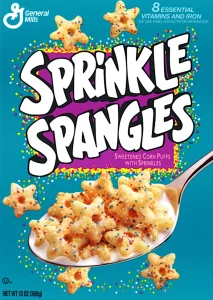
The Pitch: Star-shaped corn puffs covered in sprinkles, fronted by a genie voiced by Dom DeLuise.
What Actually Happened:
General Mills tried desperately to create the next Lucky Charms-level icon by launching a genie character clearly ripping off Disney’s Aladdin (1992). They even wrote a five-stanza poem about his “divine powers” and gave him the catchphrase “You wish it, I dish it.”
Nobody cared.
Why It Failed:
Parents took one look at sprinkle-coated cereal and said “absolutely not.” Kids thought the genie was trying too hard. The whole thing reeked of boardroom desperation.
The Verdict: Fair kill.
Sometimes a cereal is so transparently cynical that it deserves to fail. Sprinkle Spangles was cereal as IP theft, sugar as personality. The genie was retired before the cereal itself—a humiliation rarely seen in breakfast marketing.
Monopoly Cereal (2003)
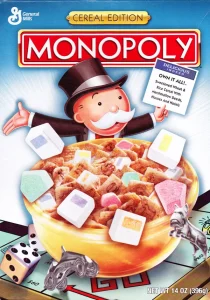
The Pitch: Cinnamon Toast Crunch with marshmallow hotels and deeds, celebrating… financial domination?
What Actually Happened:
In 2003, Hasbro was desperately trying to rehabilitate the Monopoly brand after the McDonald’s Monopoly scandal (where security officials rigged the game to steal prize money). Their solution: breakfast cereal for eight-year-olds about real estate acquisition.
Why It Failed:
The concept made no sense. Kids don’t dream about Baltic Avenue. Adults watching their weight weren’t eating marshmallow-heavy cereals. And insiders whispered it was literally just Cinnamon Toast Crunch with add-ins—no innovation, pure branding.
The Verdict: Deserved to pass GO directly to the trash.
Monopoly cereal was a limited edition cash-in that failed to generate nostalgia or repeat purchases. When even a board game this iconic can’t sell cereal, maybe the problem is trying to turn everything into cereal.
Mr. T Cereal (1984-1993)
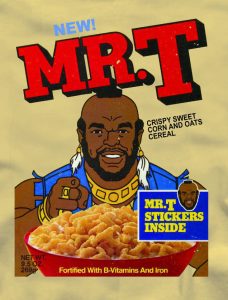
The Pitch: T-shaped corn and oat pieces, heavy sugar coating, fronted by the gold-chain-wearing A-Team star.
What Actually Happened:
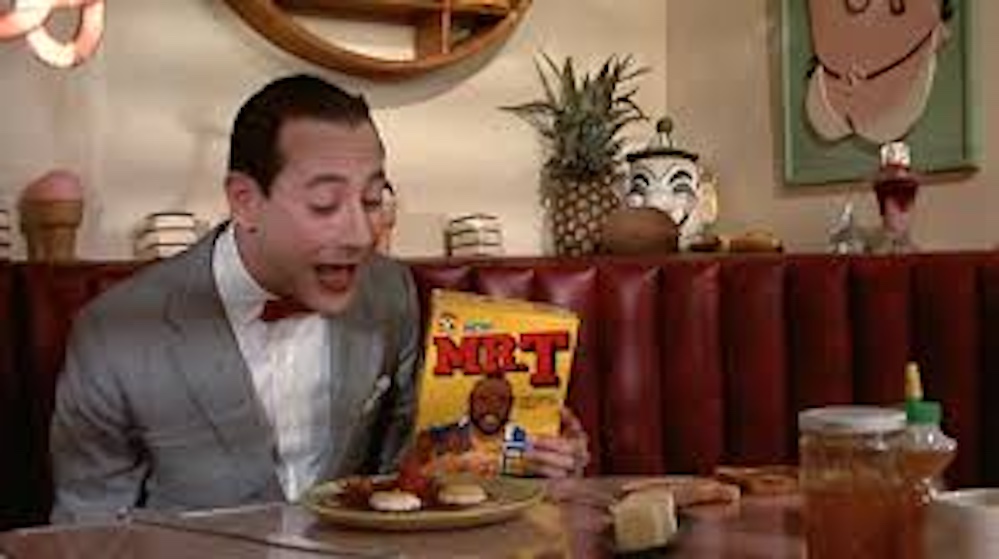
Mr. T was everywhere in the ’80s: Rocky III, The A-Team, Saturday morning cartoons. Quaker Oats capitalized brilliantly, creating a cereal that tasted like Cap’n Crunch but shaped like the letter T. It even appeared in Pee-wee’s Big Adventure (1985).
The catchphrase: “I pity the fool who don’t eat my cereal.”
Why It Failed:
Mr. T’s cultural relevance faded in the ’90s. The A-Team ended in 1987. His cartoon was cancelled. By 1993, kids had moved on to Ninja Turtles and Power Rangers. The cereal had no reason to exist without the icon.
The Verdict: Tragic but inevitable.
This actually lasted nearly a decade—impressive for a celebrity cereal. But celebrity cereals live and die with their namesake’s fame. Once Mr. T stopped being a household name, the T-shapes just became weird Captain Crunch.
Unfair ranking: Should be remembered more fondly. It worked for its era.
Waffelos (Late 1970s – Early 1980s)
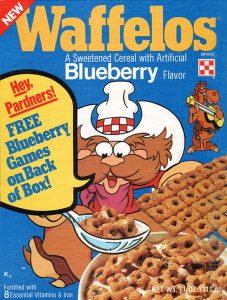
The Pitch: Maple syrup waffle-flavored cereal that stays crispy in milk, fronted by a dim-witted cowboy named Waffelo Bill and his smarter horse.
What Actually Happened:
Someone at Ralston looked at the breakfast table and thought, “What if waffles… but cereal?” The problem: if kids wanted waffles, they’d just eat actual waffles. The cereal was brittle enough to cut the roof of your mouth, then eventually got soggy anyway.
A desperate Hail Mary introduced blueberry flavor. It failed.
Why It Failed:
Kids realized the real thing was better. Also, the Western cowboy theme made zero sense for waffles. Why is Waffelo Bill dressed like he’s in a shootout? What do waffles have to do with the frontier?
The Verdict: Fair kill, but props for effort.
Waffelos represents the “why not just make it cereal?” era of product development. It’s not that it was bad—it just had no reason to exist when Eggo waffles were right there in the freezer.
Cap’n Crunch Choco Donuts (Early 2000s)
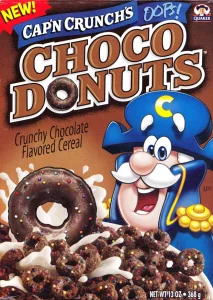
The Pitch: Donut-shaped Cap’n Crunch pieces, chocolate-flavored, covered in colorful sprinkles.
What Actually Happened:
Quaker Oats looked at an already sugary cereal (Cap’n Crunch) and thought, “What if we added chocolate AND sprinkles AND shaped them like donuts?” The result was a sugar bomb so intense it probably violated Geneva Convention rules on breakfast warfare.
They even offered a “triple chocolate” version, because subtlety is for cowards.
Why It Failed:
Too much of a good thing. Even sugar-addicted kids grinding their teeth all day couldn’t sustain this level of sweetness. Parents revolted. Dentists wept.
The Verdict: Deserved to die, but we miss it anyway.
This was excess as product design. It represented peak early-2000s “more is more” mentality. Should it have existed? No. Do we want it back? Absolutely.
Nostalgia rating: 10/10. Nutritional value: -3/10.
Pac-Man Cereal (1983-1988)
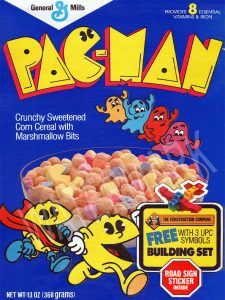
The Pitch: Marshmallow Pac-Man and ghosts (Blinky, Pinky, Inky, Clyde) plus corn puffs representing the dots.
What Actually Happened:
This was thematically perfect. You were literally eating what Pac-Man eats. General Mills went all-in: hats, watches, cameras, and even raffles for full-sized arcade cabinets.
It was essentially Lucky Charms with a Pac-Man license, but it WORKED.
Why It Failed:
Video game trends. By 1988, Pac-Man had been replaced by Super Mario Bros. Kids wanted the Italian plumber, not the yellow mouth. The cereal’s relevance died with the arcade era.
The Verdict: Tragic and unfair.
Pac-Man cereal deserved better. It was well-executed, thematically consistent, and backed by aggressive marketing. Its only crime was being tied to a fading IP.
Should return as: Retro limited edition. The nostalgia market would go insane.
Nerds Cereal (Late 1980s)
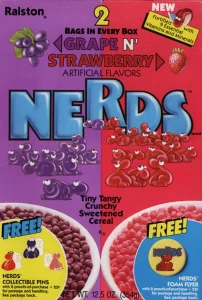
The Pitch: Two-chambered box with two flavors (orange/cherry or grape/strawberry), just like the candy. Wheat, corn, rice, and oat flour base with a candy shell.
What Actually Happened:
This was innovation. The box had two compartments. They sold special bowls with dividers and a little gate so you could mix flavors or keep them separate. It was Nerds candy reimagined as breakfast, and it was glorious.
Why It Failed:
The specialized packaging was too expensive and complicated. Rumors spread that it turned your poop different colors (it didn’t, but kids believed it). General Mills couldn’t justify the production costs.
The Verdict: A CRIME AGAINST CEREAL.
This is the most unfair discontinuation on the list. Nerds Cereal was genuinely creative, functionally interesting, and beloved. Killing it for “packaging costs” is corporate cowardice.
Petition to bring back: APPROVED.
Nickelodeon Green Slime (2003)
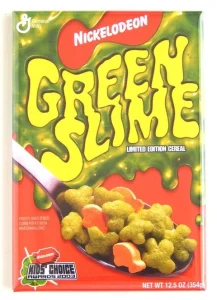
The Pitch: Limited edition puffed corn cereal with green food coloring, celebrating Nickelodeon’s Kids’ Choice Awards slime tradition.
What Actually Happened:
By 2003, Nickelodeon dominated kids’ TV (SpongeBob, Rugrats). Getting slimed at the KCAs was peak childhood achievement. General Mills capitalized with green, lumpy cereal “blobs.”
It was intentionally limited edition. Collectors bought boxes and never opened them.
Why It “Failed”:
It didn’t. It was always meant to be temporary. But that’s what makes it painful—we knew it was going away and couldn’t stop it.
The Verdict: Unfair by design.
Limited edition cereals are marketing cruelty. They create artificial scarcity, force FOMO, and deny future generations the experience. If it was good enough to sell once, bring it back annually.
Modern equivalent: Mountain Dew flavors that disappear forever.
Hidden Treasures (1993-1995)
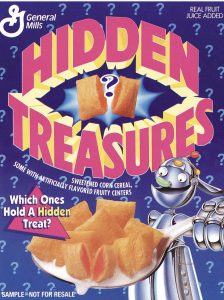
The Pitch: Corn squares with surprise fruit fillings (cherry, grape, orange)—but some were hollow with no flavor at all, teaching children about disappointment.
What Actually Happened:
General Mills created a cereal based on randomness. You never knew which flavor you’d get. The mascot was a robot named HT who wanted to ruin the surprise by checking every square.
The lore made no sense. The concept was brilliant.
Why It Failed:
Probably because crushing childhood disappointment with hollow, flavorless squares isn’t a sustainable business model. Also, the Forrest Gump “you never know what you’re gonna get” tie-in (1994) didn’t save it.
The Verdict: Unfair death for a bold concept.
Hidden Treasures was weird, but weird can be good. The randomness was the appeal. Killing it after two years didn’t give it time to become a cult classic.
Modern take: This would absolutely work as a TikTok-driven cereal today.
C-3POs (1984-1986)
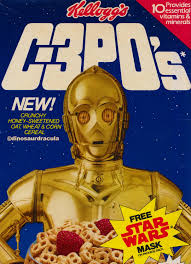
The Pitch: Star Wars merchandising cereal shaped like the letter O (or B, or the number 8, depending on who you asked). Honey-coated oats, wheat, and corn. Anthony Daniels reprised his role for commercials.
What Actually Happened:
Kellogg’s went all-in on Star Wars mania. The box had cardboard cutouts of characters. Mail-in box tops got you action figures. C-3PO looked terrified on the box art, as if aware children were about to devour him.
Why It Failed:
By 1986, Star Wars had peaked (Return of the Jedi was 1983). There wouldn’t be another film until 1999. The cereal had no reason to exist without active Star Wars hype.
The Verdict: Killed too soon.
This discontinued just THREE YEARS before the franchise would have been revived with renewed interest. If Kellogg’s had held on, C-3POs could have become a permanent Star Wars cereal line.
Prediction: When bb-8 appeared in 2015, shaped exactly like the cereal pieces, some marketing exec at Kellogg’s wept.
Injustice level: Maximum.
The Ones That Got Away (Honorable Mentions)
From the comments:
- King Vitamin – Vitamin-fortified cereal with a king mascot. Discontinued for being aggressively mediocre.
- Buc Wheats – Pirate-themed whole wheat cereal. Killed by poor branding.
- Freakies – Bizarre monsters as mascots. Too weird even for the ’70s.
- Body Buddies – Aerobics-themed health cereal. Kids don’t want to eat propaganda.
- Kaboom – Clown mascot cereal. Discontinued when clowns became terrifying.
- Ice Cream Cones Cereal – Exactly what it sounds like. Soggy nightmare.
- Original Cookie Crisp – Commenter admits it “cut my tongue” but misses it anyway.
Why Do Cereals Die?
The real reasons:
- IP licensing expires (C-3POs, Pac-Man)
- Production costs too high (Nerds’ dual packaging)
- Health backlash (Choco Donuts, Sprinkle Spangles)
- Cultural irrelevance (Mr. T, Waffelos)
- Poor sales (most of them)
- Corporate cowardice (killing cult favorites too early)
The pattern:
Cereals tied to temporary trends die with those trends. Cereals that are “too much” (sugar, complexity, weirdness) get killed by concerned parents or bean-counters.
The tragedy:
The best cereals—Nerds, Hidden Treasures, C-3POs—died because companies wouldn’t commit. They were discontinued just before they could become retro-cool.
Conclusion: The Cereal We Deserve vs. The Cereal We Get
Modern cereal aisles are dominated by the same brands from 50 years ago: Frosted Flakes, Cheerios, Lucky Charms. Innovation is dead. Risk is punished.
These discontinued cereals represent a time when companies would try anything—two-flavor boxes, celebrity mascots, video game tie-ins, literal green slime.
Some deserved to die (Sprinkle Spangles, Monopoly).
Some died too soon (Nerds, C-3POs).
Some taught us that disappointment is part of life (Hidden Treasures).
But all of them were more interesting than another iteration of Honey Nut Cheerios.
Pour one out for the cereals that dared to be weird.
They cut the roofs of our mouths, turned our milk strange colors, and made breakfast an adventure.
RIP to the real ones.
No responses yet