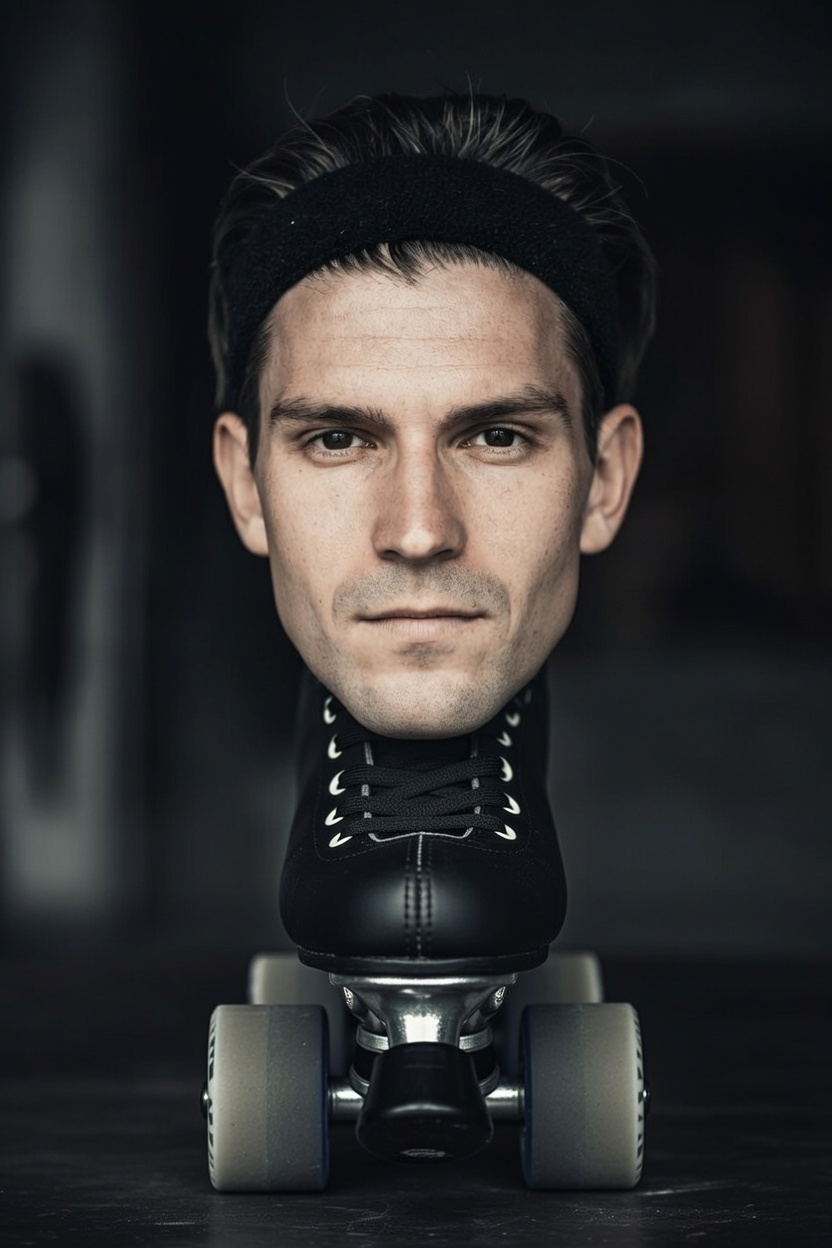
An exploration of human modularity.
Let’s be honest about what we’re asking here.
Not “could you live without your appendix” or “do you really need that gallbladder?” Those questions have been answered. The medical establishment has moved on. You can find fourteen listicles and three YouTube videos confirming that yes, you’ll survive an appendectomy just fine.
We’re asking something more fundamental.
How much of you can be removed before you stop being you?
Or, to put it in terms that might get us banned from medical journals: Could a human head, properly supported and maintained, survive on a mobility device? Say, a roller skate?

This sounds absurd. It should sound absurd. But if you think about it for more than thirty seconds—and I have, for considerably longer—it starts to seem less like a punchline and more like a legitimate philosophical and medical inquiry into the nature of human survival.
So let’s treat it seriously, I beg ye.
What We Know About Living Without Things
The human body is shockingly modular.
This isn’t speculation. This is documented medical fact, confirmed by thousands of people currently walking around with significantly fewer organs than they were born with.
You can lose:
- Your appendix (obviously)
- Your gallbladder (12% of Americans have)
- Your spleen (trauma patients, cancer survivors)
- One kidney (you’ve got a spare)
- One lung (the other one expands)
- Your stomach (gastrectomy—connect esophagus directly to small intestine)
- Most of your liver (it regenerates like a science fiction creature)
- Your entire colon (ileostomy bag replaces its function)
- Your bladder (urostomy bag)
- Your reproductive organs (common surgical procedures)
- Your thyroid (hormone replacement therapy)
You can even lose half your brain.
Hemispherectomy—the surgical removal of one entire hemisphere of the brain—is a real procedure performed on patients with severe epilepsy. The remaining hemisphere takes over most functions. These patients go on to live relatively normal lives.
So the question isn’t whether humans can survive with less.
The question is: how much less?
The Thought Experiment: Defining the Minimum
Let’s work backwards.
What do you absolutely need to be alive?
From a purely biological standpoint:
- A functioning brain (consciousness, autonomic functions)
- Oxygenation (breathing, or mechanical ventilation)
- Circulation (heart, or mechanical pump)
- Nutrition (digestive system, or IV nutrition)
- Waste removal (kidneys/liver, or dialysis)
Notice what’s not on this list: limbs, eyes, ears, skin (beyond a certain minimum), digestive organs, most of your skeleton.
Which brings us to the roller skate.
The Head: What’s Actually Required
A human head contains:
- Brain (obviously essential)
- Brain stem (controls breathing, heart rate, consciousness)
- Major arteries (carotid, vertebral)
- Spinal cord connection (at least the upper portion)
- Eyes, ears, nose, mouth (sensory input, not strictly vital)
What a head does NOT need from the body:
- Legs (mobility is external)
- Arms (manipulation is optional for survival)
- Torso (contains organs we can replace mechanically)
- Digestive system beyond the throat (we have IV nutrition)
The real question is whether the head has enough neck and upper spinal cord to maintain the brain’s connection to life support systems.
And here’s where it gets interesting.
Medical Precedent: People Who Are Mostly Just Heads
This isn’t hypothetical. There are real cases of people living with catastrophic body loss.
Stephen Hawking lived for decades with ALS, which progressively paralyzed nearly every muscle in his body. By the end, he had functional control over almost nothing except his mind. He communicated via cheek muscle twitches detected by a computer. He was, functionally, a mind in a non-responsive body, kept alive by mechanical support.
Christopher Reeve (Superman actor) was paralyzed from the neck down after a horse-riding accident. He required a ventilator to breathe. His body below the neck was essentially non-functional. Yet he lived for nine more years, advocating, creating, thinking.
Locked-in syndrome patients are conscious, aware, and mentally intact but completely paralyzed except for eye movement. They are, effectively, minds trapped in bodies that no longer respond. Some live for years, even decades.
The point: The body can be shockingly peripheral to survival.
The essential part is the brain. Everything else is infrastructure.
The Engineering Problem: Life Support Systems
Okay, so we’ve established that you don’t need limbs or organs if you have mechanical replacements. Now let’s get practical.
What would a head on a roller skate actually require?
1. Circulatory Support
The heart pumps blood to the brain. Without a body, you’d need:
- An artificial heart (LVAD – left ventricular assist device, already exists)
- Or: External circulatory pump (ECMO – extracorporeal membrane oxygenation, keeps people alive for months during lung transplants)
Both of these exist. Both are currently used in living patients.
2. Oxygenation
Lungs oxygenate blood. Without lungs:
- Mechanical ventilator (already standard in ICUs)
- Or: Oxygenated blood via ECMO (bypasses lungs entirely)
Again, not science fiction. Standard medical technology.
3. Nutrition
No stomach, no intestines. How do you eat?
- Total Parenteral Nutrition (TPN): IV feeding directly into bloodstream
- Provides all calories, vitamins, minerals
- People live on TPN for years (short bowel syndrome patients)
4. Waste Removal
No kidneys, no liver (or just the minimum necessary).
- Dialysis (kidney function replacement, thousands of people use this)
- Liver function is trickier, but you can survive with as little as 25% of your liver, and it regenerates
5. Temperature Regulation
The body regulates temperature through skin, blood flow, sweating. A head alone would struggle with this.
- Solution: Climate-controlled environment or wrap
- Medical cooling blankets already exist for fever patients
6. Immune System
Without a spleen, thymus, or much bone marrow, immune function would be compromised.
- Solution: Antibiotics, immune-suppressing or -enhancing drugs
- Transplant patients already live this way
The Roller Skate: A Question of Dignity
Here’s where we need to pause and be honest.
Technically, yes. A human head could be kept alive with current medical technology.
It would require:
- ECMO or artificial heart (circulation)
- Mechanical ventilator (breathing)
- TPN (nutrition)
- Dialysis (waste removal)
- Climate control (temperature)
- Sterile environment (infection prevention)
All of this exists. All of this is used, right now, in hospitals around the world.
But the roller skate?
The roller skate is about mobility. It’s about whether this head can move independently, interact with the world, maintain some semblance of autonomy.
And here’s the uncomfortable truth: it probably can’t.
Not because the engineering is impossible. You could mount a head (with its life support systems) on a motorized platform. Voice-controlled, even. Eye-tracking navigation. It’s doable.
But at that point, what are we preserving?
The Philosophical Problem: Identity and Dignity
In 1848, a railroad worker named Phineas Gage survived a three-foot iron rod shooting through his skull, destroying most of his frontal lobe. He lived. But his personality changed completely. He became impulsive, crude, unrecognizable to his friends.
The question his case raises: Was he still Phineas Gage?
The question the roller skate raises: If you remove everything except the brain and its immediate support systems, are you still you?
Not medically. Philosophically.
The Ship of Theseus asks: If you replace every plank of a ship, is it still the same ship?
The roller skate asks: If you remove every part of a person except their mind, are they still a person?
What We’re Really Asking
This isn’t really about roller skates.
It’s about where personhood lives.
We know, medically, that you can lose:
- Both legs (amputees)
- Both arms (thalidomide survivors)
- Your face (face transplant recipients)
- Your voice (laryngectomy patients)
- Your sight, hearing, mobility (Helen Keller)
- Half your brain (hemispherectomy patients)
- Most of your organs (transplant recipients)
And you’re still you.
So the question becomes: At what point does reduction become obliteration?
Is it when you lose autonomy? (Christopher Reeve would argue no.)
Is it when you lose the ability to interact? (Locked-in syndrome patients would argue no.)
Is it when you lose your body? (That’s what we’re testing with the roller skate.)
The Honest Answer
Could you survive as a head on a roller skate?
Medically: Yes, with extensive life support.
You’d need:
- Circulatory support (ECMO or artificial heart)
- Respiratory support (ventilator)
- Nutritional support (TPN)
- Waste management (dialysis)
- Infection prevention (sterile environment)
- Temperature regulation (climate control)
All of this exists. All of this is in use today.
Practically: No.
The amount of medical infrastructure required would be immense, immobile, and tethered to power sources and medical staff. The “roller skate” would need to be the size of a hospital bed, at minimum. You wouldn’t be mobile. You’d be a brain in a very complicated jar.
Philosophically: It depends on what you think ‘you’ are.
If you believe you are your consciousness, your memories, your thoughts—then yes, you could survive as a head on a roller skate. You’d still be you, just in a radically reduced form.
If you believe personhood requires agency, autonomy, the ability to move through and interact with the world—then no. A head on life support is alive, but it’s not living.
Why This Matters
This thought experiment isn’t absurd. It’s the logical endpoint of modern medicine.
We’ve been steadily reducing the “minimum viable human” for decades:
- Pacemakers (we can replace your heart’s rhythm)
- Dialysis (we can replace your kidneys)
- Ventilators (we can replace your lungs)
- TPN (we can replace your digestive system)
- Prosthetics (we can replace your limbs)
Each advancement asks the same question: How much can we lose and still be ourselves?
Organ transplants. Brain-computer interfaces. Artificial hearts. We’re building toward a future where the body is optional.
The roller skate is just the reductio ad absurdum.
It’s the point where we realize that survival and living are not the same thing.
The Uncomfortable Conclusion
You could, technically, survive as a head on a roller skate.
But you probably wouldn’t want to.
Because the question was never “can we keep a brain alive?”
The question was always “what makes life worth living?”
And the answer, it turns out, isn’t just consciousness. It’s agency. Connection. The ability to move through the world and leave your mark on it.
A head on a roller skate might be alive.
But it wouldn’t be living.
And maybe that’s the real lesson here: the human body isn’t a collection of optional parts. It’s the infrastructure of experience. Remove too much, and you’re not liberating the mind.
You’re just isolating it.
Postscript: We’re Already Closer Than You Think
In 2017, an Italian neurosurgeon named Sergio Canavero announced plans to perform the first human head transplant.
He didn’t succeed. But the fact that he tried—and that the medical community took it seriously enough to debate it—tells you something.
We’re not asking if we can reduce humans to heads on roller skates.
We’re asking if we should.
And that’s a much harder question.
No responses yet