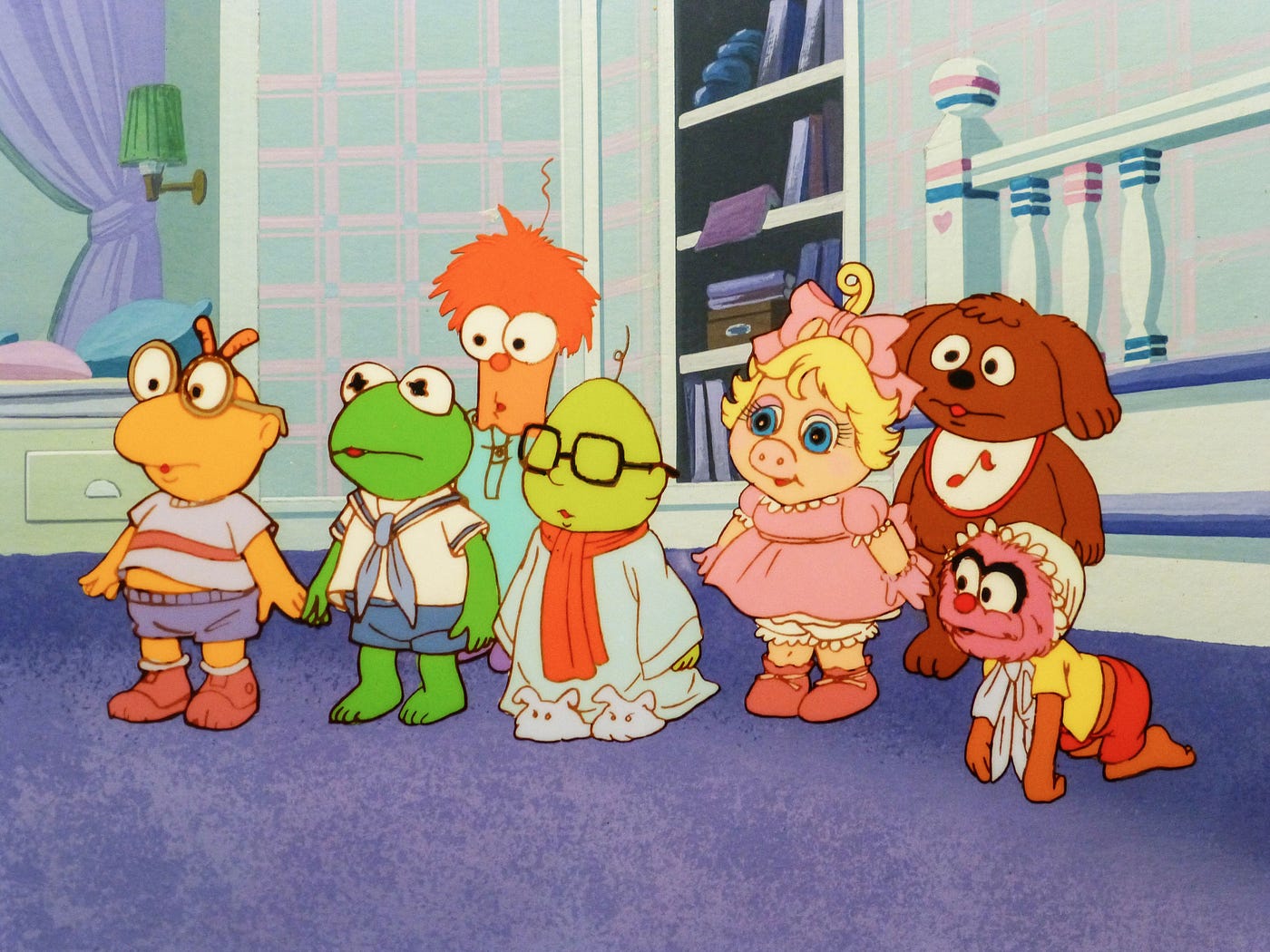
A deep dive into one of the most unlikely conspiracy rabbit holes in Saturday morning cartoon history
It’s a show about cartoon babies playing in a nursery. Kermit the Frog in a diaper. Gonzo wearing a onesie. Animal in a high chair. How could Muppet Babies — the beloved 1984 CBS Saturday morning staple — have anything to do with Scientology, L. Ron Hubbard, occult rocket scientists, or a rogue religion operating from international waters?
Well. Buckle up.
What started as a single verifiable admission from a writer has metastasized, across message boards, Reddit threads, and YouTube rabbit holes, into a sprawling web of theory, speculation, and some genuinely strange circumstantial evidence. Some of it holds up. Some of it is completely insane. We’re going to look at all of it.
The One Thing We Actually Know For Sure
Let’s start with the confirmed part, because everything else branches off from here.
Jeffrey Scott — a prolific Scientologist and the sole writer of Muppet Babies for its first three seasons — openly admitted in a 2000 interview (originally posted on a Geocities Dungeons & Dragons fan site, of all places) that he deliberately embedded Scientology concepts into the episodes he wrote. He wrote approximately 40 of the show’s 107 episodes. He also developed the show’s concept for television, meaning he shaped its DNA from the very beginning.
The specific example he gave involved what Scientologists call the “Misunderstood Word” — one of L. Ron Hubbard’s three so-called “Barriers to Study,” a cornerstone of Scientology’s educational philosophy known as Study Technology (or “Study Tech”). Hubbard claimed that when a student encounters a word they don’t understand and keeps reading anyway, everything after it becomes “blank” — they lose comprehension, feel tired or restless, and can’t absorb new information until they go back and “clear” the misunderstood word.
Scott wrote an episode called “Muppet Goose” in which Miss Piggy is reading Little Miss Muffet. When she hits the word “tuffet,” her imagination goes blank. She can’t picture anything. She can’t continue. Only once she looks up the word does her imagination spring back to life.
That is, unmistakably, Study Tech. Dressed up in a diaper. Aimed at toddlers on Saturday mornings.
Scott wasn’t shy about it. He seemed proud. He also embedded Scientology’s “Eight Dynamics” — Hubbard’s framework dividing existence into eight spheres of concern, from self to infinity — into a SuperFriends episode, having Superman espouse the concept directly.
The question, then, is not whether Scientology made it into Muppet Babies. It did. The question is: how deep does it go?
Theory #1: The Whole Show Is a Study Tech Propaganda Vehicle
The Theory: The entire premise of Muppet Babies — imaginative babies learning, problem-solving, and overcoming confusion through the power of their minds — is a thinly veiled delivery mechanism for Hubbard’s Study Technology, designed to prime children to be receptive to Scientology’s educational ideas before they could critically evaluate them.
Study Tech’s three barriers are: the Misunderstood Word, Absence of Mass (learning without real-world examples or objects), and Too Steep a Gradient (moving too fast through material). Look at almost any episode of Muppet Babies and you can map these onto the plot. The babies get confused → they slow down → they find a real-world example or object → comprehension is restored. Imagination returns. Problem solved.
The show’s tagline, repeated endlessly, is essentially “when you use your imagination, anything is possible.” The concept of imagination in Hubbard’s cosmology maps to what he called “theta” — the creative life force, the universe of thought — which he positioned as superior to the material world of “MEST” (Matter, Energy, Space, Time). The babies, trapped in a physical nursery, transcend it through pure mental force. That’s not just a cute children’s TV concept. That is, structurally, the Theta-MEST theory of Scientology.
The Debunk: The power of imagination as a children’s TV theme predates Scientology by decades and postdates it by more. Mister Rogers’ Neighborhood, The Magic School Bus, Blue’s Clues — the idea that children learn through imaginative play is a cornerstone of child development theory going back to Piaget, Vygotsky, and Friedrich Froebel in the 1800s. The show’s producer was Jim Henson, whose entire creative philosophy was rooted in the transformative power of play and imagination. Henson had zero known ties to Scientology.
Moreover, when Scott left the show after Season 3, the format didn’t change. Seasons 4 through 8 — written by a rotating team with no known Scientology affiliations — kept right on being about imagination and learning. If the study tech framing was baked in, the later writers didn’t know it, and it apparently survived without them.
The most parsimonious explanation: Jeffrey Scott was a Scientologist who happened to be writing a children’s show, and he found it easy to work in ideas that rhymed with his beliefs because those beliefs rhymed with universally accepted principles of early childhood education. Scientology didn’t invent the idea that understanding words helps comprehension. They just branded it.
Theory #2: Nanny Is L. Ron Hubbard
The Theory: The show’s most famous structural mystery is Nanny — the caretaker of the nursery who is never seen above the knees. For eight seasons, viewers only ever see her striped socks and sensible shoes. She is an all-knowing, ever-present authority figure who the children trust completely, whose face is never revealed, who appears and disappears at will, who sets the rules of the world the babies inhabit.
Theorists have noted that this maps with uncomfortable precision onto how Scientologists related to L. Ron Hubbard during his years of self-imposed exile. Hubbard spent much of the 1970s and into the early 1980s living aboard ships with the Sea Organization — Scientology’s paramilitary inner order — effectively running the church from international waters in order to evade legal and governmental scrutiny. He was everywhere and nowhere. His voice and instructions filtered down through intermediaries. He was the all-knowing authority figure whose physical presence was abstracted away but whose influence was total.
The boots/socks visual, these theorists argue, is a deliberate reference to the Sea Org aesthetic — naval dress, deck shoes, the below-the-surface presence. The Commodore, in stripes.
The Debunk: This one is genuinely fun but almost certainly false. The “Nanny’s legs only” device was a production choice made very early, and its origins have been explained practically: showing a full adult character would have shifted the show’s visual center of gravity away from the babies, made the nursery feel smaller, and required more complex animation. The rule became that no adult faces would be shown — it kept the children’s perspective dominant and the nursery feeling like its own contained world.
The inspiration for Nanny’s striped socks is generally traced to a much more mundane source: the visual comedy of adults being only partially visible from a child’s eye level. It’s the same trick cartoonists use all the time. The mystery was a feature, not a cipher.
Also, Hubbard had been dead since January 1986 — roughly 18 months into the show’s run. If the socks were a tribute to him, it’s either very early or retroactive. Neither makes much sense as intentional symbolism.
Theory #3: “The Way Out Is Through” Is Hidden in the Show’s Message
The Theory: One of Scientology’s most cited internal aphorisms — attributed to Hubbard — is “The way out is the way through.” The idea is that you cannot escape a problem by avoiding it; you must confront it directly and pass through it to find freedom. Critics of the organization have noted, with some bitterness, that this philosophy is also extremely convenient for keeping members committed through increasingly demanding and expensive stages of the church.
In Muppet Babies, the babies almost never give up. When imagination turns against them — when a fantasy becomes scary, or a problem seems unsolvable — the resolution almost always involves pushing through the fear or obstacle rather than retreating. The episode structure, again and again, is: problem arises → escape tempts → characters choose to face it → breakthrough occurs. The way out is the way through.
The Debunk: “The way out is through” as a concept long predates Hubbard. The phrase is widely attributed to Robert Frost, who used it in a 1936 poem. It echoes Stoic philosophy, Buddhist thought on attachment and suffering, and basic cognitive behavioral therapy principles. It is, frankly, just good advice.
The episode structure described above is also just… the three-act structure. Every Saturday morning cartoon from He-Man to Scooby-Doo follows that arc. Problem → temptation to give up → perseverance → resolution. If that’s Scientology, then so is every Aesop’s Fable.
Theory #4: The Jack Parsons / Hubbard / Black Magic Connection
The Theory: This one takes the longest route but is genuinely the most interesting historically — even if it takes us pretty far from the nursery.
Before Scientology existed, L. Ron Hubbard was involved in a wild episode of occult history that has since become legendary. In the late 1940s, he befriended Jack Parsons — a literal rocket scientist, co-founder of what would become the Jet Propulsion Laboratory, and a devoted follower of occultist Aleister Crowley and the Thelemic magic tradition. Parsons and Hubbard performed a series of ritual magical workings together in Pasadena called the “Babalon Working,” aimed at summoning a divine feminine force and ushering in a new spiritual age. Meanwhile — and this part is documented — Hubbard apparently also ran off with Parsons’ girlfriend and his money.
Parsons died in a lab explosion in 1952, the same year Hubbard was formally developing what would become Scientology. Conspiracy theorists argue that Hubbard essentially took the framework of Thelemic magical thought — in which the mind and will are capable of reshaping reality, in which one ascends through graduated initiatory levels to unlock hidden knowledge — and repackaged it as a pseudo-scientific religion. The thetan (Scientology’s concept of the immortal soul) maps roughly onto Crowley’s concept of the True Self or Holy Guardian Angel. The Operating Thetan levels — secret, increasingly expensive tiers of Scientology knowledge — echo Masonic or Thelemic degree systems.
The Muppet Babies tie-in: if the show is, at some level, delivering Scientology’s foundational ideas about the mind’s power over material reality, then it is also — at one further remove — delivering an idea with roots in Western occultism and Thelemic magic. Imagination reshaping reality. Children taught that their minds can conjure any world they desire. The nursery as magical working space.
And then there’s the detail that certain corners of the internet will not let go of: Bunsen and Beaker.
Consider. Dr. Bunsen Honeydew is a visionary scientist — brilliant, wide-eyed, utterly convinced of his own genius, enthusiastically conducting experiments whose consequences he seems not fully to have thought through. He is, in temperament, a man who believes that science and magic are the same thing and that the rules do not apply to him. Jack Parsons, co-founder of the Jet Propulsion Laboratory and practicing Thelemite, was exactly this kind of person: a genuine rocket pioneer who also genuinely believed he could summon supernatural entities through ritual. The lab and the altar were, for Parsons, the same room.
Beaker, meanwhile, is the one who absorbs the results. He does not fully understand what he has signed up for. He is visibly, perpetually, existentially nervous — a being of pure startled reaction, forever on the receiving end of forces he cannot control or comprehend, capable of expressing his distress only in a language no one quite understands. He goes along with it anyway. He keeps showing up.
If Parsons is Bunsen — the true believer, the man who lit the fuse — then Hubbard is Beaker: the one who arrived at the experiment already slightly afraid of it, who got closer to the magic than was wise, who emerged from the Babalon Working making a kind of strangled sound that he would spend the rest of his life trying to turn into a coherent philosophy. Naive to the actual forces at play. Running the experiments on himself and others. Meeping.
It is probably a coincidence. It is a very good coincidence.
The Debunk: This is where we have to be honest that we’ve traveled significantly from downtown into the wilderness. The historical facts about Hubbard and Parsons are real — the Babalon Working happened, it’s documented, it’s fascinating, and Hubbard’s possible theft of Parsons’ money is a matter of record. The parallel between Thelemic initiation structures and Scientology’s level system is a comparison scholars and former members have made seriously.
But the idea that Muppet Babies is transmitting occult Thelemic ideas to children through the concept of imaginative play requires so many inferential leaps that it essentially proves too much. By this logic, every story ever told about a child using imagination — from Peter Pan to Calvin and Hobbes to Sesame Street — is occult Thelemic propaganda. At some point, imagination is just imagination.
Jeffrey Scott did not claim occult influences. He claimed Study Tech influences. Those are meaningfully different things.
Theory #5: The Sea Org Connection — A Show Made From International Waters
The Theory: During the mid-1970s through early 1980s, Hubbard ran Scientology almost entirely from a fleet of ships — most famously the Apollo — operating in international waters beyond the reach of any single government’s legal authority. This era birthed the Sea Organization, Scientology’s dedicated inner cadre, who wore naval uniforms and operated under strict hierarchical discipline.
The Sea Org’s influence on the church during this period was profound and lasting. And it was during this exact period that Jeffrey Scott — per his own accounts of his career — was deepening his involvement in Scientology and developing his career as a television writer. The theory holds that Scott’s formative Scientological education happened during the height of Sea Org influence, when the church’s messaging was most intensely controlled and propagandistic, and that Muppet Babies was a direct downstream product of that formation.
The Debunk: Possible as biographical context, unprovable as causal claim. Many people were involved with Scientology during the Sea Org era and went on to do things that had nothing to do with transmitting church doctrine. The chain from “Scott was shaped by Sea Org-era Scientology” to “therefore the show encodes Sea Org ideology for children” is speculative. Scott himself only ever claimed the Study Tech influence — not any broader Sea Org-derived mission.
Theory #6: The Show Was the Thin Edge of a Wedge
The Theory: Scientology has had a long, documented interest in reaching children before they can critically evaluate its claims. Applied Scholastics — one of Scientology’s front organizations — promotes Study Tech in schools around the world, often without disclosing the Scientology connection. The theory here is that Muppet Babies was part of a broader, deliberate strategy to make children familiar with Scientology concepts before they were old enough to recognize them as such: pre-loading the cognitive framework that Study Tech relies on, so that children who later encountered Study Tech materials would find them intuitively familiar.
In other words: the show wasn’t just one guy sneaking in his beliefs. It was soft marketing. Preschool recruiting.
The Debunk: There is zero evidence that this was a network, studio, or institutional Scientology strategy. CBS, Marvel Productions (which produced the show), and Jim Henson Productions have no documented ties to Scientology. Jeffrey Scott was one writer who was open about his personal beliefs influencing his personal work. He was not acting as a church agent.
The story here — a true believer working their values into their art — is a completely ordinary human thing that happens across every religion, ideology, and philosophy. Catholic screenwriters write Catholic themes. Libertarian novelists write libertarian themes. A Scientologist writing Study Tech themes into a children’s show is the same phenomenon, just with more provocative branding.
That said: Scott wrote 40 episodes. He developed the show’s concept. His fingerprints on the show’s DNA are real, whether or not there was any institutional backing behind them.
What The Other Writers Said
It’s worth giving airtime to the pushback from within the production itself. One of the show’s story directors and head designers — who worked on Muppet Babies for six seasons — responded to Scott’s claims with considerable irritation. He said Scott’s scripts were heavily rewritten by the storyboard team, that the finished episodes bore only a loose resemblance to what Scott turned in, and that Scott “must never have watched them” to be so boastful about his influence.
This is important context. Even if Scott intended to embed Scientology concepts in every script, the production pipeline between script and finished episode was long and involved many hands. The ideas that made it to air may have been more diluted — or more transformed into something ordinary — than Scott’s self-accounting suggests.
What Actually Holds Up
Strip away the wild theories and you’re left with this:
The man who created and wrote Muppet Babies was a committed Scientologist who deliberately worked his beliefs into at least one episode, probably more. The show’s central philosophy — that imagination is a force that transcends physical limitation, that confusion can be cleared through confrontation and understanding, that the way through difficulty is forward — has genuine structural parallels with Scientological thought, even if those parallels also exist in a hundred other traditions.
The deeper theories — Nanny as Hubbard, the Babalon Working at the nursery, the Sea Org in the striped socks — are mostly creative confabulation. They’re the kind of pattern-matching that happens when you stare at something innocuous long enough.
But the core fact is real, it’s documented, and it’s bizarre enough on its own merits: for at least the first three seasons, someone was using Miss Piggy and Gonzo to teach L. Ron Hubbard’s theory of why students fail to comprehend what they read.
That the show was charming and beloved anyway might be the most Muppet Babies thing of all.
Sources and further reading: Jeffrey Scott’s original interview (archived from Geocities via the Wayback Machine), Boing Boing’s 2002 coverage, the Carnegie Mellon analysis of Scientology’s Study Technology, and approximately nine hundred Reddit threads.
No responses yet