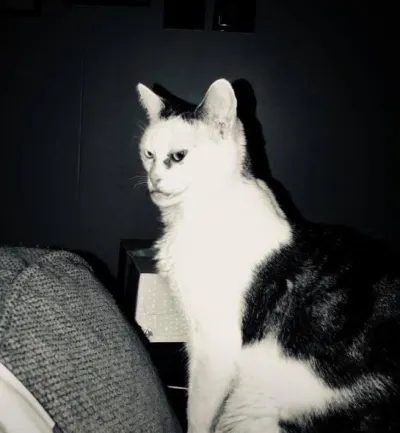
You have heard it. You have maybe even tried it. You sit across from your cat, make extended eye contact, and say a word very slowly and clearly — “hel-lo” — the way people talk to foreigners — and your cat blinks, or looks away, or begins washing itself with the aggressive indifference of someone who has been in many meetings and found all of them pointless.
And yet. There are videos. There are whole corners of TikTok dedicated to cats who appear to say “mama.” There is a Maine Coon named Chloe who has three million views. There is a cat in Italy who seems to say “Buongiorno,” and who has caused more theological crisis in the comment sections than most papal encyclicals.
So is it possible? Can you teach your cat to speak English?
Let us take this seriously. Scientists have, and we must trust the science.
First, Let’s Understand Why It’s “Currently Impossible”
Before we get to the seven methods, we need to understand the problem. Because the problem is not stubbornness. It is not lack of intelligence. It is not that your cat doesn’t understand you — though it often doesn’t, by choice. The problem is engineering.
The Vocal Anatomy Issue
Human speech is produced through a highly specific collaboration between the larynx, vocal cords, tongue, lips, teeth, soft palate, and nasal cavity. English alone uses 24 consonant phonemes and 15 vowel phonemes — 39 distinct meaningful sounds that require rapid, precise coordination of all these parts working in concert. When you say the word “strength,” for example, you are performing a small miracle of articulation involving sounds that most of the animals on earth are physically incapable of producing.
A cat’s vocal anatomy is built for a completely different purpose. Their larynx and vocal cords are optimized for the sounds that served their wild ancestors: the hiss to warn off rivals, the yowl to signal reproductive availability, the chirp to track prey, the purr (which is produced by a unique laryngeal dilator muscle rhythmically constricting the glottis — cats can purr while both inhaling and exhaling, which humans cannot do at all). What cats are not built for is the fine motor control of tongue-against-palate that produces a “t,” or the lip closure that produces a “p” or “b,” or the dental-labial friction that produces an “f” or “v.”
Their tongues are shaped differently. Their lips are less mobile. Their soft palate is configured differently. The coordination between these structures and their vocalizations follows a different neural pathway, one not wired for the kind of precision speech requires.
Humans are capable of around 600 consonant sounds and 200 vowel sounds as a species — we don’t use all of them in any one language, but we have the hardware. Cats have a total repertoire of approximately 21 distinct vocalizations. These cover a useful range of emotional states — pain, contentment, need, aggression, alarm — but they do not include anything approaching the combinatorial complexity of language. Cats do not combine sounds to form words. They do not have words. They have moods, expressed acoustically.
The Neurology Issue
It goes beyond anatomy. Human language requires not just the hardware to produce sounds, but the neural architecture to organize them into meaning — to understand that sounds in sequence carry referential content, that “cat” means a thing, that stringing “cat” + “is” + “hungry” means a state of the world. Cats recognize approximately 25-35 words in their owner’s vocabulary, primarily their name and words associated with food, but their relationship to those words is closer to Pavlovian response than semantic understanding. They know “treat” the way you know that a phone ringing means someone wants to talk — not because they understand phones, but because the association has been drilled in.
This is not a moral failing. Cats evolved as solitary hunters who did not need complex vocal language for group coordination. Wolves — the ancestors of dogs — needed to communicate in packs to coordinate hunts, establish hierarchy, signal danger across distances. That social pressure drove more sophisticated vocal processing. Cats mostly hunted alone. They mainly needed to know if something was bigger than them or smaller than them.
Has Any Progress Been Made?
Surprisingly: a little bit, yes.
Researchers at Cornell University documented hundreds of cat vocalizations and confirmed that while cats are not using language, they have become remarkably skilled at manipulating the humans who care for them through acoustic means. The domestic cat’s meow is essentially a tool invented specifically for human communication — adult cats almost never meow at each other. The meow is cat-to-human technology, evolved over 5,000 years of cohabitation, and individual cats customize it for individual owners. Your cat’s meow is, in a meaningful sense, a personal dialect spoken only to you.
The “mama” videos on TikTok are real in a specific sense: cats can produce sounds that, to primed human ears, resemble the syllable “mama.” What’s happening is that a cat’s distress or hunger vocalizations sometimes produce a roughly bilabial nasal sound that resembles the “m,” followed by an open vowel, repeated. “Mama” is also one of the most acoustically simple words in any language — which is why it appears in so many languages as the word for mother. It requires almost no consonantal precision. The cat is not saying “mama.” But when you’re listening for it, your auditory system does the rest.
There is also a documented phenomenon of cats adapting their vocalizations to match the tonal patterns of their owners’ voices, and learning when a particular sound produces a particular result. This is operant conditioning, not language. But it is not nothing.
Method 1: Immersive Total English Exposure
The theory: simply speak to your cat constantly and exclusively in English. Narrate everything. “I am now opening the refrigerator. You cannot have this. This is cheese.”
The reality: cats in English-speaking households have been hearing English for their entire lives and have not spontaneously begun speaking it. However — and this is genuine — cats do attune to their owners’ speech patterns and will produce vocalizations that loosely mirror the rhythm and pitch contours of what they’re hearing. If you consistently use a rising inflection when asking your cat a question, your cat may develop a rising inflection in its responses. This is not English. It is conversational mirroring. It is also, frankly, very cute, and may be the ceiling.
Method 2: Reward-Based Sound Shaping
The theory: start with any vocalization your cat produces, reward it, then gradually shape it toward something more resembling a word through incremental reinforcement — the same technique used to train parrots.
The problem: parrots are vocal mimics by evolutionary design. Their syrinx — the bird equivalent of a larynx — is extraordinarily flexible and is wired directly to a brain region devoted to copying sounds they hear. They learn by imitation. Cats do not learn by imitation in the same way. A cat that is rewarded for meowing will meow more. It will not meow differently in a direction that eventually produces “hello.”
That said, some behaviorists have reported cats who, through extensive shaping over months, produce sounds that in isolation resemble specific syllables — “ow” for “out,” an approximation of “now” for food. The reports are anecdotal. The success rate is low. The effort required is enormous. But it is not zero.
Siamese and other Oriental breeds appear to have both more vocal range and more interest in vocal communication than, say, a Persian. If you are going to try this, get a Siamese. This is also generally good life advice.
Method 3: Should You Start with a Different Language?
Here is where we get genuinely interesting.
The argument: English is a phonologically demanding language. It contains sounds — the “th” in “the,” the “r” in “red,” the “w” in “water” — that are notoriously difficult even for human adult learners whose native languages don’t include them. If the goal is to find the language whose phoneme set is most compatible with what a cat can physically produce, English is probably not your best starting point.
What would be better?
Japanese is phonologically minimal — it uses primarily CV (consonant-vowel) syllables, avoids complex consonant clusters, and has a small vowel inventory of only five pure vowel sounds. The word for fish in Japanese is sakana — three clean, simple syllables. No clusters. No “th.” No “str.” This is far closer to cat-capable territory than “strengths,” which is, phonologically, an act of violence.
Hawaiian is even simpler — it has only eight consonants.
Mandarin Chinese, being tonal, is interesting for a different reason: cats are naturally tonal communicators. The pitch of a meow carries emotional information the same way tones in Mandarin carry semantic information. A cat that already uses pitch variation meaningfully might, in theory, be better positioned to approximate tonal distinctions than consonantal ones.
And Hebrew? This requires a brief tangent. Biblical Hebrew — specifically, ancient spoken Hebrew — makes relatively less use of lip-closure consonants (the bilabials like “p,” “b,” “m”) and more of fricatives and gutturals that come from deeper in the throat. The “ch” sound in “Chanukah” is a velar fricative that, interestingly, cats can approximate in their hiss and growl register. The “ayin,” a pharyngeal consonant no longer used in most modern Hebrew, is gone precisely because it’s hard for modern Hebrew speakers to produce. For a cat? Unknown. Possibly worth investigating. Almost certainly not worth the effort.
The conclusion of this tangent: if you are seriously committed to teaching your cat to approximate speech, start with Japanese. Then — and only then, once that’s going well — transition to English. And by “going well” we mean the cat has not simply left the room.
Method 4: Start with 1600s English (The Shakespeare Strategy)
The argument has a certain logic to it. Modern English — particularly American English — is phonologically richer and in some ways more demanding than the English of Shakespeare’s time. The “r” sound has changed significantly. The Great Vowel Shift, which ran roughly from the 14th to the 17th century, radically reorganized English vowel sounds. Early Modern English (the English of Shakespeare, the King James Bible, the 1611-era language) had a somewhat different consonant inventory than what we speak today — it lacked some of the fricative complications that accumulated later, and its vowels were arguably more open and less diphthongized.
Old English, however — the Anglo-Saxon of Beowulf, spoken roughly 500 to 1100 AD — is where things get genuinely interesting for our purposes. Old English had no affricates (the “ch” and “dj” sounds in “church” and “judge”), fewer voicing contrasts in its fricatives, and relied more heavily on sounds that exist in the range of feline vocalization. It sounded more guttural, more Germanic, with harsher consonant clusters that are not actually consonant clusters in the cat’s vocal register but rather held, sustained fricatives.
Is Beowulf-era English easier for a cat than modern English? Almost certainly not in any useful way. But there is a romantic appeal to the idea of a cat growling out something vaguely resembling “Hwæt!” — the opening exclamation of Beowulf, which is roughly equivalent to “Listen!” or “Hey!” — and we should not dismiss romance when it is all we have.
The practical takeaway: Early Modern English contains more open vowels and fewer of the truly problematic fricatives that developed later. A cat attempting “thou art” is dealing with two open syllables and one soft fricative, versus the modern “you are,” which contains a vowel cluster and that diphthong-heavy “you” that cats have no mechanism to produce. Start with “thou.” It is both more achievable and more distinguished.
Method 5: Dogs vs. Cats — Who Is Closer?
Dogs are significantly closer to producing human speech sounds than cats, and the research on this is fairly unambiguous.
First, neurologically: dogs have a vocal brain region that functions analogously to the human temporal lobe’s speech-processing center. When dogs hear human voices, the same areas of their brains activate that activate in humans hearing voices. Cats process human vocalizations too, but through different and more general auditory pathways.
Second, anatomically: canine vocal fold tissue has been found to be almost identical to human vocal fold tissue in terms of material properties — the same Young’s modulus (elasticity measurement), the same layered structure. The canine larynx has been used as a model for studying human voice disorders precisely because of this similarity. Cat vocal tissue diverges more substantially.
Third, behaviorally: dogs demonstrably attempt to mimic human speech in a way cats do not. The famous examples — dogs that produce something resembling “I love you,” “hello,” or their owner’s name — are not random coincidences. These dogs are actively attempting to reproduce sounds they have heard and been rewarded for. The neurological pathway from hearing a sound to attempting to reproduce it is more robust in dogs. Stanley Coren, the dog behaviorist, has documented the mechanism: owner hears the dog making a sound that resembles a phrase, says the phrase back enthusiastically, dog repeats the sound, gets a treat, cycle reinforces. Over time, the dog’s vocalization drifts closer to the target.
Does this mean dogs can speak English? No. What they produce is vowel-heavy, consonant-poor, approximate — “ahh rooo uuu” for “I love you,” “ah woo” for “hello.” The bilabial stops (“p,” “b”) are largely absent. The precision consonants are not there. But the approximation is genuinely astonishing compared to anything a cat can produce.
One important anatomical reason dogs do better: their lips are more mobile. Not as mobile as human lips, but more so than cats. That slight advantage, combined with the vocal mimicry drive, is what produces a YouTube video of a dog appearing to say a word versus a YouTube video of a cat appearing to say “mama” in a very specific type of distressed meow that only sounds like “mama” because you’ve been told it does.
If you have a dog, your odds are better. We are sorry. Your cat is aware of this and does not care.
Method 6: Speech Buttons (The Cheating Method)
We would be remiss not to mention this, because it works, in the sense that it produces a talking animal in your home.
Speech buttons — recordable buttons that play a pre-recorded word when pressed — have been used extensively with dogs and with some cats to create rudimentary communication systems. You record “food,” “outside,” “play,” “no.” The animal learns to press the button associated with the concept they want to communicate. Several dogs have become minor celebrities for this. Some cats have also been trained to use them, though with less reliability and considerably more attitude — cats that have learned to press the “no” button reportedly use it primarily to tell their owners “no” in contexts that were not intended.
This is not teaching your cat to speak English. It is teaching your cat to operate a keyboard, which, given everything, might be the more impressive achievement.
Method 7: Wait for Evolution
The longest-term strategy, and possibly the most realistic.
Domestic cats have been living with humans for approximately 10,000 years, and in that time they have already developed the meow — a vocalization that did not exist in their wild ancestors, invented specifically for human communication. They have tuned its frequency to roughly match the frequency of a human infant’s cry, because that frequency triggers a hardwired caregiving response in humans. Cats did not consciously do this. Evolution did it, because cats that were better at communicating with humans survived better.
If cats remain in close co-evolutionary relationship with humans for another 50,000 to 100,000 years, will selection pressure nudge their vocal anatomy toward sounds that are more humanlike? We genuinely don’t know. The question has barely been studied. What we do know is that domestication can change vocal anatomy — domesticated animals across many species have different vocalizations than their wild counterparts, in directions that tend toward being more legible to humans.
Your cat will not live to see this. You will not live to see this. Nobody currently alive will live to see this. But somewhere, in a future that is difficult to imagine, there may be a cat that can say something resembling “actually” in a flat, faintly judgmental tone.
We think you’ll agree that will be worth the wait.
So Is This All Just a Bad Idea?
Honestly? No, it’s a fine idea.
It is a bad idea if your goal is to have a cat that speaks English. That is not going to happen. The anatomy doesn’t work, the neurology doesn’t work, the evolutionary history doesn’t work, and frankly the cat’s fundamental disposition toward meeting your needs does not work.
But it is not a bad idea to try to communicate better with your cat — and the research consistently shows that the way to do that is not to drag the cat toward human language, but to move yourself toward feline communication. Slow blinking (the cat’s equivalent of a relaxed, trusting gaze) communicates affection in a language cats already speak. Matching your cat’s vocalization patterns when they talk to you signals attunement. Learning to read tail position, ear angle, and body posture gives you access to the vast majority of what your cat is actually saying.
Your cat is already talking to you. All the time. In a language it invented partly for your benefit, which is actually a rather touching thing when you stop to consider it.
The cat just doesn’t want to talk in yours. And there is something, if we are being honest about it, extremely on-brand about that.
Further reading: Cornell University’s feline vocalization studies; Stanley Coren’s “How to Speak Dog”; the NIH study on canine vocal fold tissue; and the entire comment section of any TikTok video of a cat saying “mama,” which contains multitudes.
No responses yet