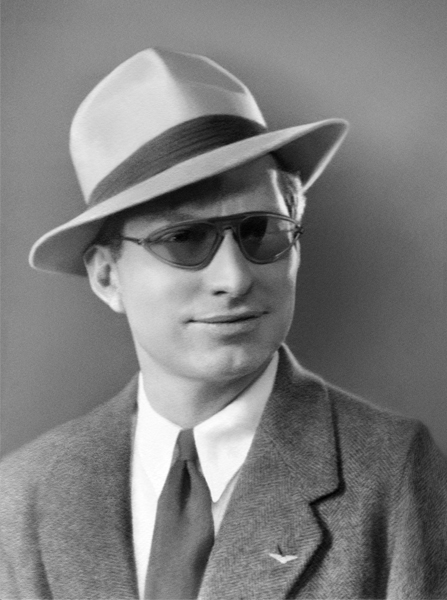
How a sci-fi writer built a religion, sailed the high seas to escape the feds, stole a rocket scientist’s girlfriend, convinced Tom Cruise he’s right about everything, and turned Clearwater, Florida into a company town. Oh, and there’s a galactic dictator named Xenu who nuked frozen aliens in volcanoes 75 million years ago. You know, standard stuff.
L. Ron Hubbard did more in one lifetime than most people could accomplish in several reincarnations (which, according to Scientology, you’ll get anyway, so there’s that).
He was:
- A prolific pulp sci-fi writer
- Naval officer (some say he exaggerated his service record, but that’s just what critics claim)
- Founder of Dianetics, the bestselling self-help book of 1950
- Creator of an entire religion with millions of followers worldwide
- Captain of his own private navy that cruised international waters
- Subject of FBI raids
- Tax-exempt religious leader
- The guy who convinced Hollywood’s biggest stars that an alien overlord named Xenu is why you have psychological problems
Some uncharitable people call him a con man. But let’s be real: if you can convince millions of people to believe in body thetans, sign billion-year contracts, and pay hundreds of thousands of dollars to learn about intergalactic genocide, you’re not a con man—you’re a visionary.
Or maybe both. Let’s find out.
Who Was L. Ron Hubbard? (The Man, The Myth, The Commodore)
Lafayette Ronald Hubbard (1911-1986) was born in Nebraska, grew up traveling the world with his Navy officer father, and claimed to have had adventures that would make Indiana Jones look like a librarian.
According to Hubbard:
- He spent time in Asia learning ancient wisdom from Tibetan monks
- He was a nuclear physicist
- He was blinded and crippled during WWII, then cured himself using the principles that would become Dianetics
- He sailed the seven seas, explored uncharted territories, and had incredible adventures
According to his critics (and, well, military records):
- He never studied nuclear physics
- His Navy service was mostly administrative and unremarkable
- He wasn’t blinded or crippled during the war
- Most of his adventure stories were… creative embellishments
But here’s the thing: Who cares if he exaggerated? The man wrote over 1,000 published works, created a global movement, and built something that outlasted him by decades. Most people can’t even finish NaNoWriMo.
The Early Years:
Hubbard started as a pulp fiction writer in the 1930s-40s, cranking out sci-fi and adventure stories for magazines. He was prolific, fast, and decent at it. Not award-winning literature, but he paid the bills.
Then in 1950, he published Dianetics: The Modern Science of Mental Health.
And everything changed.
Dianetics: The Bullshit That Started It All (Or: Legitimate Breakthrough in Mental Health?)
Dianetics (published May 1950) became an instant bestseller.
The core idea:
- Your mind has two parts: the analytical mind (rational, conscious) and the reactive mind (unconscious, where trauma is stored)
- Traumatic experiences create engrams (mental scars) that cause irrational behavior, phobias, psychosomatic illness
- Through a process called auditing (guided recall therapy), you can erase engrams and reach a state called Clear
- A Clear person is free from psychosomatic illness, has perfect memory recall, higher IQ, and enhanced abilities
Critics say:
- It’s pseudoscience with no empirical basis
- The medical and psychiatric communities rejected it immediately
- The American Psychological Association called it “unproven claims”
- It’s just repackaged Freudian psychoanalysis mixed with sci-fi
But consider:
- Dianetics sold millions of copies and stayed on bestseller lists for years
- Thousands of people reported genuine improvements in their lives
- The auditing process (essentially talk therapy with a galvanometer—the E-meter) helped people confront past trauma
- It offered a systematic self-improvement framework when mainstream psychology was inaccessible to most people
The E-meter (electropsychometer):
- Measures galvanic skin response (basically a lie detector repurposed)
- Used during auditing to detect emotional reactions
- Hubbard claimed it could measure thought and locate engrams
- Critics call it “alien ghost detector” (we’ll get to that)
Was Dianetics revolutionary or bullshit?
Well, it worked for some people. Testimonials poured in. Communities formed. People swore it changed their lives.
Then again, the placebo effect is powerful, and confirmation bias is real.
But also, if something genuinely helps people feel better, does it matter if the underlying theory is questionable?
(Spoiler: The psychiatric establishment thought it mattered a lot, and that tension would become a core part of Scientology’s identity.)
From Self-Help Book to Religion: The Speedrun
1950: Dianetics published, massive success
1951: Dianetics Foundation collapses financially (turns out running a national organization is expensive)
1952: Hubbard develops new concepts—thetans (immortal spiritual beings), past lives, reincarnation
1953: Church of Scientology officially founded
Why turn it into a religion?
Hubbard’s explanation: He discovered that humans are immortal spiritual beings (thetans) who have lived countless lifetimes, and this is fundamentally a spiritual matter, not just psychology.
Critics’ explanation: He was facing financial troubles and legal challenges from practicing medicine without a license. Religions get tax exemptions.
The famous quote (allegedly) from Hubbard: “If you want to make a little money, write a book. If you want to make a lot of money, start a religion.”
(Hubbard denied saying this. Multiple witnesses claimed he said it at a sci-fi writers’ meeting in 1948. Who knows. Either way, it’s a hell of a quote.)
What we know for sure:
- Scientology became a religion
- It got tax-exempt status (eventually, after decades of fighting the IRS)
- It made a LOT of money
Was it a cynical tax dodge?
Some people think so. But plenty of religions started with charismatic leaders who had revelations and built organizations. Scientology just happened to do it faster and more openly than most.
The Jack Parsons Incident: Stealing a Rocket Scientist’s Girlfriend (And His Money)
Before Scientology took off, Hubbard had an interesting… let’s call it “business arrangement”… with Jack Parsons.
Who was Jack Parsons?
A brilliant, legitimately important figure:
- Co-founder of the Jet Propulsion Laboratory (JPL)
- Pioneer in solid rocket fuel technology
- Actual rocket scientist (not exaggerating—he helped America get into space)
- Also: devoted follower of Aleister Crowley’s occult order, Ordo Templi Orientis (O.T.O.)
- Practiced sex magic rituals
- Had an open relationship with his girlfriend, Sara “Betty” Northrup
Enter L. Ron Hubbard (1945):
Hubbard moved into Parsons’ house (nicknamed “The Parsonage”) in Pasadena. The two became friends. They performed occult rituals together. Hubbard participated as Parsons’ “scribe” during the Babalon Working—a sex magic ritual designed to summon a goddess.
(Yes, the guy who later founded Scientology was doing sex magic with a rocket scientist. Keep up.)
Then things got messy:
Sara Northrup fell for Hubbard. Parsons, despite his open-relationship philosophy, became intensely jealous.
1946: Hubbard proposed a business venture—buying yachts in Florida, sailing them to California, and selling them for profit. Parsons invested his life savings: $20,970 (about $250,000 today).
Hubbard and Sara took the money, went to Florida, bought yachts, and… disappeared.
Parsons flew to Florida to track them down. He found them literally pushing off from the dock.
According to critics: Hubbard conned Parsons, stole his money and girlfriend, and fled.
According to Hubbard’s version (later): It was a legitimate business deal that went sour. Relationships are complicated. Parsons eventually got some money back.
According to Aleister Crowley (Parsons’ occult mentor, via telegram): “Suspect Ron playing confidence trick. Jack evidently weak fool. Obvious victim prowling swindlers.”
Outcome:
- Parsons got about $2,900 back in a settlement
- Hubbard married Sara (despite still being married to his first wife—oops)
- Sara later became integral to developing Dianetics
- The marriage ended very badly (accusations of kidnapping, abuse, blackmail—messy stuff)
- Parsons died in 1952 in a mysterious explosion in his home lab
So did Hubbard steal Parsons’ girlfriend and money?
That’s certainly one interpretation. Others might call it “a business dispute and romantic entanglement between consenting adults.”
Either way: Parsons helped invent rocket fuel that got us to the moon. Hubbard invented a religion with millions of followers. Both are impressive in their own way.
The Sea Org: When Your Religion Needs a Navy
By the late 1960s, Hubbard faced problems:
- Governments in the U.S., U.K., and Australia were investigating Scientology
- The FDA raided Scientology offices
- The IRS was circling
- Bad press everywhere
Hubbard’s solution: “Fuck this. I’m going to sea.”
1967: Hubbard established the Sea Organization (Sea Org)—a fraternal religious order operating from a fleet of ships.
The Setup:
- Three ships: Diana, Athena, and Apollo (flagship)
- Hubbard styled himself Commodore
- Crew wore naval uniforms with ranks
- They sailed international waters, primarily the Mediterranean
Official explanation: The Sea Org was established for “advanced research” and to avoid government harassment.
Critics’ explanation: Hubbard was fleeing authorities and operating outside any country’s jurisdiction.
The Sea Org Today:
- No longer at sea (mostly)
- Now the elite religious order within Scientology
- ~5,000-6,000 members
- Staff all the top management positions
- Members sign billion-year contracts
Wait. Billion-year contracts?
Yes.
The Church’s explanation: “The first Sea Organization members formulated a one-billion-year pledge to symbolize their eternal commitment to the religion. It is a symbolic document which, similar to vows of dedication in other faiths and orders, serves to signify an individual’s eternal commitment to the goals, purposes and principles of the Scientology religion.”
In practice:
- Members pledge to serve Scientology for a billion years
- They believe they’ll reincarnate and return to the Sea Org in future lives
- The Sea Org motto: “Revenimus” (“We Come Back”)
- If you leave the Sea Org, you get a “freeloader’s bill”—retroactively charged for all auditing and training received
Critics describe it as:
- Totalitarian
- A cult within a cult
- Intensive surveillance, lack of freedom
- Essentially signing your life away
Defenders say:
- It’s a legitimate religious order, like monks or nuns
- Members join voluntarily
- They’re free to leave (with a freeloader’s bill, but still)
Honestly?
Signing a billion-year contract is objectively wild. But hey, Catholic priests take vows of celibacy for life. Mormon missionaries commit years of their youth. Tibetan monks renounce worldly possessions.
Religious dedication takes many forms. This one just happens to involve naval cosplay and paperwork binding you through multiple incarnations.
Xenu and the Space Opera: Why Tom Cruise Believes in Alien Ghosts
Here’s where it gets really interesting.
Most Scientologists don’t know about Xenu. Only about 10% ever reach the level where it’s revealed.
You have to:
- Spend years in Scientology
- Pay $100,000+ for courses and auditing
- Reach the state of Clear (free of reactive mind)
- Complete Operating Thetan (OT) levels I and II
- Finally reach OT III
Only then do you learn about Xenu.
The Story (OT III, revealed in 1967):
75 million years ago, the Galactic Confederacy (76 planets around larger stars) was severely overpopulated. The average planet had 178 billion people. (Earth currently has 8 billion, so… yeah, very crowded.)
The head of the Confederacy was Xenu (also spelled Xemu).
Xenu’s solution to overpopulation:
- Mass kidnapping – Summoned billions of people for “tax inspections”
- Drugged and paralyzed them
- Froze them in ethylene glycol (yes, antifreeze)
- Transported them to Earth (then called “Teegeeack”) in spacecraft that looked like DC-8s (but without engines, because space)
- Stacked them around volcanoes (including Hawaii)
- Dropped hydrogen bombs into the volcanoes, killing everyone
But wait, there’s more:
The explosion didn’t just kill the bodies—it released their thetans (souls/spirits).
Xenu didn’t want them to reincarnate, so he:
- Captured the thetans
- Forced them to watch 36 days of confusing films full of false information
- Implanted them with lies (they were told they were God, the Devil, Christ, etc.)
- This is called the “R6 implant” or “Incident II”
These traumatized, brainwashed thetans are still here.
They’re called body thetans, and they attach themselves to human bodies—including your body.
According to Scientology:
- You’re covered in alien ghosts from Xenu’s genocide
- These body thetans cause psychological problems, illness, negative emotions
- OT III teaches you to locate and “audit out” these body thetans
- You hold both cans of the E-meter in one hand, address the body thetans telepathically, and guide them through Incident II
- This is a long, painstaking process
- OT levels IV-VII continue dealing with more body thetans
What happened to Xenu?
He was captured after a six-year rebellion by loyal officers and imprisoned in an electronic mountain trap, where he remains to this day.
Hubbard’s warning:
The OT III materials are dangerous. Reading them without proper preparation can cause pneumonia and death. The “R6 implant is calculated to kill anyone who attempts to solve it.”
(Spoiler: Thousands of people have read the Xenu story online. No pneumonia epidemic. But sure.)
Does Tom Cruise Really Believe This?
Short answer: Yes.
Long answer:
Tom Cruise is OT VII (possibly OT VIII, the highest public level). He’s spent decades and millions of dollars in Scientology.
So yes, Tom Cruise believes:
- He has body thetans from Xenu’s genocide 75 million years ago
- He’s worked to audit them out
- Scientology gave him superpowers (not officially claimed, but heavily implied)
- Psychiatry is evil
- He can help save the world through Scientology
Other celebrity Scientologists who know about Xenu:
- John Travolta (OT VII)
- Kirstie Alley (OT VII, before she died)
- Likely others at high levels
Beck’s family:
- Beck Hansen’s parents were Scientologists
- Beck grew up in Scientology (though his involvement level is unclear)
Why don’t they talk about it publicly?
Because Scientology teaches:
- The Xenu story is sacred and confidential
- Revealing it to the unprepared can harm them
- It’s taken out of context by critics
- The media mocks it because they don’t understand
The Church’s official position:
When directly asked about Xenu, Scientology spokespeople have:
- Denied it’s part of their teachings
- Called it “anti-Scientology propaganda”
- Refused to comment
- Eventually, when confronted with Hubbard’s own handwritten OT III documents, admitted it’s real but confidential
In 2008, Scientology spokesman Tommy Davis initially denied the Xenu story. When a reporter started reading from Hubbard’s own writings, Davis got defensive and admitted it was authentic but confidential.
So yes, it’s real. And yes, they believe it.
Clearwater, Florida: Scientology’s Company Town
In 1975, Scientology wanted a land base in the U.S. for advanced training.
They chose Clearwater, Florida.
How they did it:
Used a front company called “United Churches of Florida” and “Southern Land Development and Leasing Corporation.”
What they bought:
- Fort Harrison Hotel ($2.3 million cash)
- Nearby bank building ($550,000 cash)
The cover story: United Churches was “a non-profit organization dedicated to church unity” that would sponsor interfaith radio programs.
Nobody knew it was Scientology.
1977: FBI Raid
The FBI raided Scientology headquarters and uncovered documents marked “Top Secret” detailing “Project Normandy”—Scientology’s plan to take over Clearwater.
Project Normandy’s stated purpose: “Obtain enough data on the Clearwater area to be able to determine what groups and individuals [we] will need to penetrate and handle in order to establish area control.”
The plan included:
- Infiltrating local government offices
- Planting spies in the state attorney’s office, Chamber of Commerce, and local newspaper
- Identifying “friends” vs. “enemies”
- Framing the mayor (Gabe Cazares) in a staged hit-and-run
- Spreading rumors about the mayor’s personal life
- “Neutralizing” opposition
Mayor Gabe Cazares called it “the occupation of Clearwater” and “a paramilitary operation by a terrorist group.”
The Church’s response:
They deny ever trying to take over the city. (The FBI documents say otherwise, but okay.)
Clearwater Today:
Since 2017, the Church of Scientology and companies run by its members have bought 92+ properties in downtown Clearwater.
- Total downtown land controlled by Scientology: ~100 acres
- Purchased through LLCs to hide ownership
- Most bought in cash
- Properties mostly sit empty
- Scientology controls much of the retail district around their headquarters
The Fort Harrison Hotel is now called the “Flag Land Base”—Scientology’s spiritual headquarters where advanced OT levels are delivered.
Is Clearwater a Scientology town?
Well…
The Church is the largest property owner in downtown. They control development. The city government has limited ability to oppose them.
But also:
Scientology invested millions in the city, preserved historic buildings, and employs thousands.
Whether that’s “revitalization” or “takeover” depends on who you ask.
E-Meters: Alien Ghost Detectors or Legitimate Spiritual Technology?
The E-meter (Hubbard Electropsychometer) is central to Scientology practice.
What it is:
- A galvanometer that measures electrical resistance in the body (galvanic skin response)
- Basically a lie detector repurposed for auditing
- The person holds two metal cans connected to the meter
- The auditor asks questions and watches the needle
What Scientology claims it does:
- Detects areas of spiritual distress
- Locates engrams and body thetans
- Measures the state of your thetan
- Guides you to spiritual freedom
What critics say:
- It’s just measuring sweat and skin conductivity
- Same technology as a polygraph (which isn’t even admissible in court)
- It’s a prop to make the process seem scientific
- “Alien ghost detector” is an accurate description
Cost: ~$5,000 for an official Scientology E-meter
FDA ruling (1963): The E-meter is a legitimate device for use in religious counseling only. Scientology cannot claim it diagnoses or treats disease.
Does it work?
As a biofeedback device: Sure. It measures physiological responses.
As a spiritual technology: That’s between you and Xenu.
Why Do People Still Buy Into Scientology?
This is the real question.
With all the exposés, leaks, lawsuits, and South Park episodes mocking it… why do people join and stay?
Here’s the charitable view:
1. The auditing process genuinely helps some people
Sitting down for hours of guided introspection, confronting past trauma, talking through problems—that’s essentially therapy. Some people experience real breakthroughs.
2. Community and belonging
Scientology provides:
- Tight-knit social network
- Clear goals and progression system
- Sense of purpose (saving the planet!)
- Support during hard times
3. It works (for them)
Tom Cruise credits Scientology with curing his dyslexia and helping him succeed.
Testimonials from members describe life-changing transformations:
- Overcoming addiction
- Improved relationships
- Better career success
- Sense of spiritual fulfillment
If it works for you, does it matter if the underlying cosmology is weird?
4. Celebrity endorsement
When Tom Cruise and John Travolta say it changed their lives, that’s powerful social proof.
5. The gradual reveal
You don’t start with Xenu. You start with:
- Personality test (free!)
- Intro courses (affordable)
- Dianetics auditing (helps with immediate problems)
- Communication course (actually useful skills)
By the time you get to body thetans, you’re years in, thousands of dollars invested, surrounded by fellow believers.
Sunk cost fallacy + social pressure + genuine positive experiences = staying
6. Philanthropy and good works
Scientology runs:
- Narconon (drug rehabilitation—though critics question effectiveness)
- Applied Scholastics (literacy programs)
- The Way to Happiness (moral code booklets)
- Volunteer Ministers (disaster relief)
- Citizens Commission on Human Rights (anti-psychiatry activism)
Members see the Church doing good in the world.
7. It provides answers
Most religions require faith in things you can’t prove. Scientology offers a systematic explanation for:
- Why you have problems (engrams, body thetans)
- How to fix them (auditing)
- What happens after death (reincarnation, you come back)
- Your place in the universe (you’re an immortal spiritual being)
For people seeking meaning, that’s appealing.
The less charitable view:
- Gradual indoctrination
- Manipulation through “disconnect” policy (shunning critics and ex-members)
- Financial pressure and debt
- Information control
- Psychological coercion
- Fear of losing community and family
But let’s be real:
Every major religion has aspects that seem irrational to outsiders. Virgin birth. Transubstantiation. Reincarnation. Resurrection. 72 virgins. Body thetans from Xenu’s volcano genocide.
They’re all weird if you don’t believe them. They’re all meaningful if you do.
The Good Scientology Does (No, Really)
Critics focus on the scandals, but Scientology does run legitimate programs:
Narconon (drug rehab):
- Operates treatment centers worldwide
- Uses Hubbard’s detox methods (sauna, vitamins, exercise)
- Critics question effectiveness and cite low success rates
- Supporters say it saved their lives
Applied Scholastics:
- Literacy and education programs
- Uses Hubbard’s “Study Technology”
- Operates in dozens of countries
- Helps thousands of students
The Way to Happiness:
- Secular moral code booklet
- Distributed in disaster areas and high-crime neighborhoods
- 21 precepts (common-sense stuff like “don’t steal,” “be industrious”)
Volunteer Ministers:
- Provide disaster relief (earthquakes, hurricanes, floods)
- Offer “spiritual first aid”
- Criticized for proselytizing during crises, but… they do show up
Is it all a recruitment tool?
Probably partially.
But also:
If Narconon helps one person get sober, does it matter that the underlying theory involves thetans?
If Volunteer Ministers distribute supplies after a hurricane, does it matter they’re Scientologists?
The answer depends on your cynicism level.
The Dark Side: What Critics Say
Look, we’ve been pretty charitable so far. But let’s acknowledge the serious allegations:
1. Disconnection Policy
Members are required to “disconnect” from anyone declared “Suppressive Person” (SP)—including family members who leave or criticize Scientology.
Result: Families torn apart, children cut off from parents.
The Church says: It’s like excommunication in other religions. People are free to choose.
2. Fair Game Policy
Former policy (officially canceled in 1968, but critics claim it’s still practiced):
Anyone declared SP “may be deprived of property or injured by any means… May be tricked, sued or lied to or destroyed.”
The Church says: That policy was canceled decades ago.
Critics say: The practice continues through harassment, lawsuits, and intimidation.
3. The Rehabilitation Project Force (RPF)
Sea Org members who screw up get sent to the RPF:
- Hard labor
- Minimal sleep
- No outside contact
- Can last months or years
The Church says: It’s a voluntary rehabilitation program.
Critics call it: Forced labor camp.
4. Financial exploitation
- Courses cost tens of thousands
- Pressure to donate for “status levels”
- Some members go into massive debt
- If you leave, you may get a “freeloader’s bill”
5. Abuse allegations
Ex-members report:
- Physical abuse
- Psychological manipulation
- Forced abortions (Sea Org members aren’t allowed children)
- Cover-ups of crimes
The Church denies all abuse allegations.
6. Mysterious deaths
Several high-profile deaths at Scientology facilities:
- Lisa McPherson (1995) – died during a Scientology “Introspection Rundown”
- Others in Clearwater and elsewhere
The Church says: Tragic accidents, not their fault.
What do we make of this?
If even 10% of the allegations are true, there are serious problems.
The Church’s defense: Disgruntled ex-members lie for attention and money.
The truth is probably somewhere in the middle, but the sheer volume of consistent allegations is… concerning.
Can Scientology Be Good Despite Everything?
Here’s the uncomfortable question:
Can an organization do both legitimate good AND cause serious harm?
Answer: Yes. Most large institutions do.
Scientology:
- Helps some people overcome addiction and find meaning
- Also: Allegedly tears families apart and exploits members financially
The Catholic Church:
- Runs hospitals, schools, and charities serving millions
- Also: Sex abuse scandals and cover-ups
Twelve-step programs:
- Save countless lives from addiction
- Also: Can become cultish and replace one dependency with another
The U.S. Military:
- Provides education, purpose, and stability for millions
- Also: PTSD, abuse scandals, questionable wars
So is Scientology a force for good or evil?
Yes.
Both.
Simultaneously.
For some people, Scientology is the best thing that ever happened to them. It saved their lives.
For others, it destroyed their families and left them in debt.
Both can be true.
L. Ron Hubbard’s Legacy: More Interesting Than You
Love him or hate him, L. Ron Hubbard accomplished something remarkable:
He built a belief system from scratch that:
- Survived his death
- Spans the globe
- Has millions of adherents
- Generates billions in revenue
- Influences powerful people
- Owns significant real estate
- Operates a private navy (kind of)
- Has its own intelligence operations
- Fought the IRS and won
And he did it starting with a typewriter and a wild imagination.
Was he a con man?
Some people think so.
Was he a visionary spiritual leader?
His followers believe so.
Was he a brilliant writer who understood human psychology and built something unprecedented?
Objectively, yes.
The Xenu story is bananas.
Sure.
But so is every religion’s origin story when you’re not a believer.
A virgin birth? Bananas.
A burning bush that talks? Bananas.
Reincarnation based on karma? Bananas.
A prophet flying to heaven on a horse? Bananas.
Xenu nuking frozen aliens in volcanoes? Okay, that’s extra bananas.
But Scientologists believe it. And they’ve built their lives around it. And some of them are happy.
Who are we to judge?
(Well, okay, we can judge a little. It’s pretty out there.)
The Bottom Line
L. Ron Hubbard:
- Started as a pulp sci-fi writer
- Published a bestselling self-help book
- Created a religion
- Sailed the high seas with his own navy
- Fought governments and won tax exemptions
- Built a billion-dollar organization
- Convinced Hollywood stars to believe in body thetans
- Turned Clearwater, Florida into a company town
- Left behind a legacy that’s equal parts inspiring and disturbing
Say what you want about the man, but he did more in one lifetime than most people dream of doing.
Some call him a charlatan.
That’s their interpretation, I suppose.
Others call him a genius.
Also defensible.
Xenu agrees: L. Ron Hubbard was more interesting than you.
And honestly? Xenu would know. He’s been watching for 75 million years.
Final Thoughts:
Is Scientology a legitimate religion or an elaborate con?
Yes.
Does it help people or hurt them?
Yes.
Should you join?
Probably not. But if Tom Cruise personally invites you, it’d be rude to say no.
P.S. – If you’re reading this and you’re a Scientologist: Hi! I know you’re trained to spot “entheta” (enturbulative theta—negative energy). This article is meant with respect. If anything here offends you, please don’t sue. I’m just a humble blogger named Vernan who thinks your founder led a wild life.
P.P.S. – If you’re reading this and you’re Xenu: Sorry about being imprisoned in that electronic mountain for 75 million years. That’s rough, buddy.
For more information on Scientology: The Church has extensive resources at scientology.org. For critical perspectives, check out ex-member testimonies and documentaries like “Going Clear” and Leah Remini’s “Scientology and the Aftermath.” Make up your own mind. Or let the E-meter decide. Your call.
No responses yet