The Game (What We Think We Know)
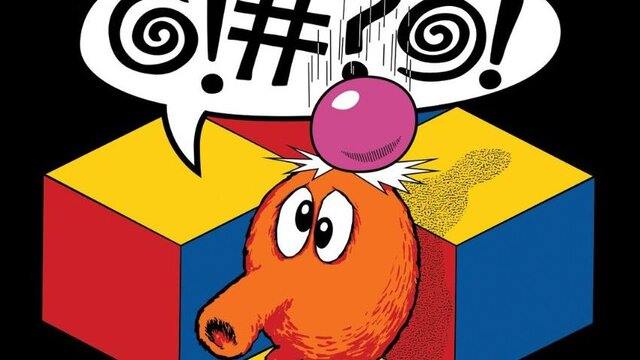
In 1982, an orange creature appeared in arcades across America. Q*bert—or, as the cabinet originally read during testing, “@!#?@!”—was presented as a simple game: hop on cubes, change their colors, avoid the snake. Jump on all the cubes, advance to the next level. Die when you fall off. Swear in incomprehensible symbols when you do.
The gameplay was elegant. The character was memorable. The game became the third most successful arcade title of its era, behind only Pac-Man and Donkey Kong.
But nobody—not the designers, not the marketing team, not the cartoon writers who later tried to flesh out his world—ever explained what Q*bert actually is.
The Great Question: What Species is This?
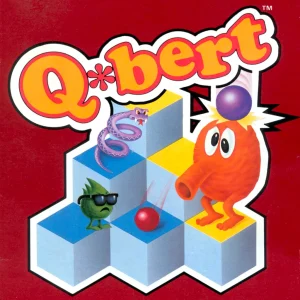
Let me be perfectly clear about the scope of this mystery: Qbert is not simply “a video game character.” He is a fur-covered, two-legged, tube-nosed organism who exists within a very specific ecosystem. He has a girlfriend (Qtee). He has a brother (Qbit). He has friends (Qball, Qval, Qmongus). There are others of his kind (Qbertha, Qdina, Q*Dirk).
This is not a lone specimen. This is a species.
And we have no idea where they came from or what they are.

The Physical Form: An Anatomical Survey
Let us begin with what we can observe:
Body Structure:
- Spherical torso, approximately 18-24 inches in diameter (estimated from arcade sprite proportions)
- No discernible neck
- Two legs (short, stumpy, digitigrade stance)
- Orange fur covering the entire body
- No visible arms in the wild (game) state
- Large, perpetually open eyes (suggests crepuscular or nocturnal adaptation)
The Nose-Tube:
- Tubular proboscis, roughly 6-8 inches in length
- Functions as mouth, nose, and (originally) weapon delivery system
- Can produce loud “thunking” sounds (death vocalization)
- Emits symbol-filled speech bubbles when distressed
- Articulated enough for feeding and vocalization
Locomotive Capabilities:
- Exclusively diagonal hopping (no forward/backward movement observed)
- Can clear distances of approximately 3 feet per hop
- No flight capability without mechanical assistance (flying discs)
- Falls at normal Earth gravity when leaving pyramid structures
Now here’s where it gets weird.

The Biological Impossibility Problem
Q*bert’s body presents several physiological challenges that would, in any Earth-based organism, result in immediate extinction:
Problem 1: The Armless Condition
Qbert has no arms. None. His original design included them (artist Jeff Lee drew him with stubby appendages), but programmer Warren Davis removed them to simplify controls. The Saturday Supercade cartoon gave him arms—put him in a red and white jacket, gave him opposable thumbs—but the actual Qbert, the wild-type specimen, is completely armless.
How does an armless, spherical organism:
- Feed itself?
- Groom its fur?
- Manipulate objects?
- Defend against predators?
- Court a mate?
- Eliminate waste?
The tube-nose provides some answers. It was originally designed to shoot “mucus bombs” (Lee’s term), suggesting it’s a multipurpose appendage capable of both offense and feeding. The fact that Q*bert can catch green balls and interact with flying discs suggests the nose-tube has prehensile properties we don’t fully understand.
Problem 2: The Hopping-Only Locomotion
Q*bert moves exclusively in diagonal hops. This is not a game mechanic—this appears to be a genuine biological limitation. The rotated joystick controls mirror how the creature actually moves: 45-degree angles only, no adjustment possible.
From an evolutionary standpoint, this is insane. An organism that can only move diagonally would:
- Be unable to navigate natural terrain (what about obstacles directly in front?)
- Waste enormous energy on inefficient pathing
- Be incredibly vulnerable to predators with conventional movement
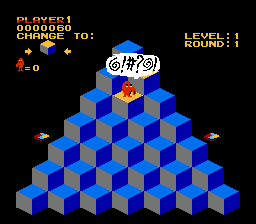
And yet Q*bert not only survives—he thrives in pyramid environments specifically designed for diagonal movement. This suggests either:
A) Qbert’s habitat naturally consists of isometric cube structures, or B) Qbert is a designed organism, engineered for pyramid navigation
Problem 3: The Fur
Why is Qbert covered in fur? He lives on geometric pyramids made of cubes. There’s no indication these pyramids are in cold climates. The Saturday Supercade cartoon placed them in QBerg, a 1950s American town, suggesting temperate conditions.
Fur requires:
- Regular maintenance (Q*bert has no arms)
- Significant caloric intake (metabolically expensive)
- Vulnerability to overheating during intense physical activity (constant hopping)
Unless… the fur serves another purpose. Some possibilities:
- Sensory function (like whiskers, but full-body)
- Protection from the cube-surfaces (cushioning repeated impacts)
- Thermoregulation in an environment with extreme temperature swings
- Sexual selection (Q*bertha is described as having “messy hairs sprouting upwards”—fur quality may indicate genetic fitness)
Problem 4: The Survival Mechanics
Q*bert dies if he:
- Falls off the pyramid edge
- Touches red balls
- Makes contact with Coily (the snake)
- Encounters Ugg or Wrongway (the sideways-gravity monsters)
But he survives:
- Touching green balls (freezes enemies, grants points)
- Jumping on Slick and Sam (green creatures that undo his work)
- Riding flying discs
This suggests Q*bert has an extremely specific biochemical vulnerability profile. He’s not fragile per se—he can hop indefinitely, land on sharp cube corners, and survive high-speed disc transport—but certain stimuli cause instant death.
The most likely explanation: Contact toxins. Red balls and snake skin may secrete compounds that are instantly fatal to Q*bert’s species. This would explain why touching them doesn’t wound him—he simply dies, as if from venom or cyanide exposure.
The Pyramid Question: Egypt? Babylon? Ur? Or Something Else Entirely?
Every Q*bert game takes place on pyramids. Not ramps. Not cubes scattered randomly. Pyramids.
This is too specific to be coincidence.
Ancient Pyramid Theory
The obvious assumption: Q*bert is from Earth, specifically from a culture that built pyramids. Candidates include:
Egypt (2600 BCE – 1500 BCE):
- Giza pyramids constructed with precise geometric angles
- Step pyramids predating smooth-sided versions
- Q*bert could be a species that evolved to inhabit these structures after human abandonment
- Problem: No orange fur-bearing mammals native to Egypt capable of bipedal locomotion
Mesoamerica (1000 BCE – 1500 CE):
- Mayan and Aztec step pyramids geometrically similar to Q*bert’s environment
- Jungle climate would explain fur (humidity control)
- Ritualistic color-changing could relate to religious practices
- Problem: Still no biological candidates, and the timelines don’t match the 1950s setting
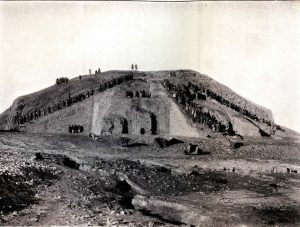
Ancient Mesopotamia (Ziggurats, 3000 BCE – 500 BCE):
- The oldest pyramid-like structures on Earth
- Located in modern Iraq (ancient Ur, Babylon)
- Built as temples to the gods
- Could Q*bert be a temple-dwelling species, specifically adapted to ziggurat life?
But here’s the problem with all of these theories:
The cubes change color when touched.
That’s not how stone works. That’s not how anything works. Unless these aren’t stone pyramids at all.
The Impossible Architecture Theory
What if the pyramids aren’t ancient structures but active, technological environments?
Evidence:
- Cubes respond to touch – This is electronic, not geological
- Flying discs appear and disappear – Suggests teleportation or materialization technology
- Enemies spawn from balls – Coily hatches from a purple sphere like an incubator
- Gravity anomalies – Ugg and Wrongway move sideways defying physics
- Instant level transitions – No time passes between pyramid completion and next level
This isn’t a natural habitat. This is a facility.
The Saturday Supercade Evidence: Q*Berg and the Noser Population
In 1983, CBS aired Saturday Supercade, giving Q*bert a cartoon backstory. And it’s deeply strange.
Q*Berg: A 1950s Town Made of Cubes
The show placed Qbert in QBerg, a town that is:
- Explicitly set in 1950s America (drive-ins, malt shops, leather jackets)
- Populated entirely by “nosers” (the canonical species name)
- Architecturally dominated by cube-shaped buildings
- Attended by Q*Burg High School (teenage nosers in an educational system)
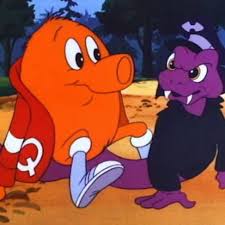
This raises questions the show never answered:
- Why is it the 1950s? Is this actually the 1950s, or is Q*Berg a retro-themed environment?
- Where is Q*Berg? No U.S. town is made entirely of cubes. This suggests either:
- An isolated commune of nosers maintaining period aesthetics
- A simulated environment (like the pyramids)
- A parallel dimension where cube architecture is standard
- Why cubes specifically? Is this religious? Cultural? Biological necessity?
The Noser Biology (What the Cartoon Tells Us)
Saturday Supercade gave us critical taxonomic details:
Sexual Dimorphism:
- Males (Qbert, Qbit, Qball, Qmongus): Smooth fur, athletic build
- Females (Qtee, Qval, Qbertha): Varied presentations, Qbertha notably has “messy hairs sprouting upwards”
Social Structure:
- Nuclear families (Q*bert has a father and brother)
- Romantic pair-bonding (Qbert and Qtee are dating)
- Unrequited attraction (Qbertha is “madly in love” with Qbert, suggesting non-monogamous mating competition)
Technological Adaptation:
- Can wear clothing (Q*bert’s red and white jacket)
- Possess arms in social settings (contradicts game biology)
- Speak English (game version only produces “@!#?@!” symbols)
- Ride motorcycles, attend school, use “slippy-doos” (weaponized nose-balls creating oil slicks)
This suggests phenotypic plasticity—the ability to express different body forms depending on environment. Wild Qberts (game version) are armless. Socialized QBerts (cartoon version) develop functional limbs.
This is extremely weird and suggests either:
- Metamorphosis (like tadpoles developing legs)
- Mechanical augmentation (cartoon arms are prosthetics)
- Two different species using the same name
The C64 Connection: Are There Other Species in the Pyramid Ecosystem?
Here’s where I depart from conventional game history and enter pure xenobiology:
What if Q*bert isn’t alone?
The Commodore 64 era produced several “Q*bert-like” games, dismissed by historians as mere clones. But what if they document related species sharing the same ecological niche?
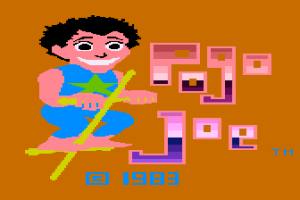
Pogo Joe (1983): The Human Variant?
Species: Homo saltator (hypothetical)
Observed Characteristics:
- Humanoid boy on a pogo stick
- Navigates barrels instead of cubes (cylindrical vs. cubic habitat preference)
- Can jump over obstacles (suggests superior locomotive evolution)
- 65 different level configurations (wider habitat range than Q*bert)
- Enemies hatch from colored “eggs” (shared reproductive strategy with Q*bert ecosystem)
Hypothesis: Pogo Joe may be a human who has adapted to life in the pyramid realm, using technology (pogo stick) to mimic Q*bert’s hopping locomotion. If true, this suggests the pyramid environment is accessible to multiple species, not exclusive to nosers.
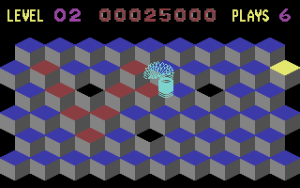
Slinky (1984): The Mechanical Organism
Species: Mechanicus spiralis (hypothetical)
Observed Characteristics:
- Literally a metal spring (toy slinky)
- Changes color of cubes by bouncing
- Vulnerable to rust (water + dust cloud = rusted slinky dragged away by oil can)
- Affected by magnets (Marge the Magnet can grab Slinky mid-hop)
- Requires point maintenance (loses points per hop, must collect bonuses to survive)
Hypothesis: Slinky may be either: A) A fully mechanical pyramid-navigator created by the same civilization that built the structures B) A silicon-based lifeform mimicking Q*bert’s behavior through convergent evolution C) A symbiotic organism (metal spring + living core)
The rust mechanic is particularly telling—Slinky requires specific atmospheric conditions to survive. Too dry: vulnerable to magnets. Too wet: rusts and dies. This suggests extreme environmental specialization.
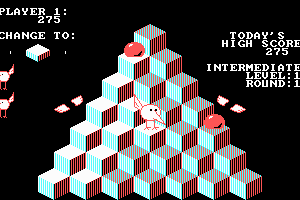
J-Bird (1983): The Avian Parallel
Species: Avis cubicolus (hypothetical)
Observed Characteristics:
- “Delightful yet foul-mouthed wingless bird” (per documentation)
- Changes cube colors identically to Q*bert
- Faces King-Bo the snake (parallel to Coily)
- Has access to wing platforms (can temporarily fly)
- Encounters Hob and Nob (frogs that reverse cube colors)
Hypothesis: J-Bird represents either: A) A bird species that has lost flight capability while adapting to pyramid life (like flightless cormorants) B) A noser variant with avian characteristics (suggesting nosers may not be mammals at all) C) Convergent evolution—separate species arriving at identical pyramid-navigation solutions
The fact that J-Bird can temporarily regain flight using platform wings suggests its flightlessness is recent (evolutionarily speaking).
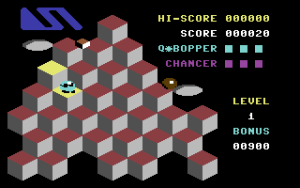
Q-Bopper (1983): The Shadow Specimen
Species: Unknown
Observed Characteristics:
- Extremely obscure, minimal documentation
- Also known as “Rodeo,” “Follow the Leader,” “Balls,” “Merlin’s Puzzle,” “Cube Slinker”
- Same pyramid-hopping behavior
- Released same year as Q*bert
Hypothesis: Q-Bopper may be: A) A subspecies of Qbert (geographic variant) B) An earlier evolutionary form C) A deliberate mimicry species (Batesian mimicry—pretending to be Qbert to survive)
The multiple names suggest Q-Bopper was either widely distributed across regions (each culture naming it differently) or it was hidden/suppressed (names changed to avoid detection).
The Ecosystem Hypothesis: What If They’re All Related?
What if I told you all of these organisms—Q*bert, Pogo Joe, Slinky, J-Bird, Q-Bopper—share a common ancestor?
Consider the shared traits:
- Pyramid-exclusive habitation
- Color-changing cube interaction
- Diagonal hopping locomotion (or technology mimicking it)
- Spherical enemy avoidance (balls, eggs, orbs)
- Snake-type apex predator (Coily, King-Bo)
- Platform refuge systems (flying discs, wings)
This isn’t convergent evolution. This is adaptive radiation.
The Pyramid Radiation Theory
Hypothesis: 10,000-100,000 years ago, a founding population colonized the first pyramid structure. Over millennia, descendant species adapted to different micro-niches:
- Q*bert line: Fur-covered, tube-nosed, optimized for standard cubic pyramids
- J-Bird line: Feathered, beak-nosed, retained limited flight
- Pogo Joe line: Tool-using biped, overcame diagonal-only locomotion through technology
- Slinky line: Abandoned biology entirely, became mechanical, achieved perfect pyramid resonance
- Q-Bopper line: Unknown specialization, possibly went extinct or into deep hiding
The pyramids themselves may be the key: engineered environments designed to test locomotive adaptation. Each species represents a different solution to the same problem: efficiently navigate an isometric cube structure while avoiding predators and changing colors.
But who built the pyramids? And why?
The Builder Question: Who Made the Pyramids?
Let’s examine the candidates:
Hypothesis 1: Ancient Human Civilization
The Saturday Supercade 1950s setting might be a clue. What if Q*Berg is a preserved pocket of time—a society that reached the 1950s and stopped, either by choice or force?
The architecture (all cubes), the cultural stasis (permanent 1950s aesthetics), and the isolated population (only nosers, no humans) suggests this isn’t Earth’s 1950s. It’s a replica.
Possible explanations:
- Time loop (Q*Berg repeats 1955-1959 forever)
- Museum world (nosers are living exhibits)
- Post-apocalyptic remnant (Q*Berg survived nuclear war by hiding in cube structures)
Hypothesis 2: The Qu Connection (Speculative)
There exists, in speculative evolution literature, a species called the Qu—advanced aliens who reshape organisms to suit specific environments. They’re known for:
- Creating pyramid structures
- Genetically engineering species for bizarre adaptations
- Testing organisms in controlled habitats
- Disappearing after experiments conclude
What if Q*bert and the nosers are Qu creations?
Evidence:
- Impossible biology (armless, diagonal-only movement)
- Purpose-built physiology (perfectly adapted to pyramids, nowhere else)
- Population control (limited species, specific ecosystem)
- No fossil record (because they’re engineered, not evolved)
The Qu would explain everything: why nosers only exist in pyramid environments, why the biology doesn’t make sense, why there’s a whole ecosystem of pyramid-hoppers—because they were all made for this purpose.
But this raises a darker question: What was the experiment testing?
Hypothesis 3: The Pyramids Are Prisons
What if Q*bert isn’t living in his natural habitat?
What if he’s trapped?
Evidence:
- Cannot leave pyramid edges (instant death)
- Forced to complete levels to progress (compulsion or captivity?)
- Enemies spawn infinitely (artificial pressure)
- No visible exit (where does Q*bert go between levels?)
- Wreck-It Ralph (2012) showed Q*bert homeless after his game was unplugged
The “game over” might be literal: Q*bert lives in a simulation or enclosed facility, and when you lose all lives, the experiment ends. The pyramids aren’t homes—they’re testing chambers.
This would explain:
- Why leaving the pyramid means death (it’s outside the containment field)
- Why the architecture is impossible (it’s artificial)
- Why Q*bert can never stop hopping (he’s being studied under stress conditions)
- Why there’s a 1950s town (nosers in captivity maintain cultural simulation to prevent psychological collapse)
Conclusion: The Unsettling Truth
After this exhaustive field study, I must report the following:
Q*bert is a fur-covered, armless, tube-nosed, orange organism of unknown taxonomic origin who is biologically adapted—or possibly engineered—to live exclusively on pyramidal structures made of color-changing cubes.
He is not alone. A whole genus of pyramid-dwelling hoppers exists: J-Bird, Pogo Joe, Slinky, Q-Bopper, and likely dozens more we haven’t documented. They share an ecosystem, face similar predators, and navigate identical environments.
But here’s what keeps me up at night:
We don’t know if they’re there by choice or by design.
Is Q*bert the last survivor of an ancient pyramid-building civilization? Is he a genetically engineered test subject? Is he from Earth at all?
The Saturday Supercade cartoon tried to give him a normal life—high school, a girlfriend, a leather jacket—but that just makes it stranger. Why would a species with such extreme specialization (diagonal hopping, color-changing compulsion) develop suburban American culture?
Unless Q*Berg itself is the experiment.
Maybe the 1950s town is just another pyramid—same traps, same tests, same limits—but disguised as normalcy. Q*bert goes to school, rides a flying disc home, falls in love, and never realizes he’s in a cage made of cubes.
And that snake, Coily, is still chasing him.
It always will be.
FIELD NOTE ADDENDUM:
I tried to find Q*berg on a map. It doesn’t exist.
I tried to find a pyramid made of color-changing cubes. They don’t exist.
I tried to find an orange, furry, armless creature that hops diagonally and swears in symbols.
Only in the game.
Only ever in the game.
This research was conducted in the field (arcade cabinets, C64 emulators, Saturday morning television archives) between 1982 and 2026. No nosers were harmed in this study, though several fell off pyramids.
No responses yet