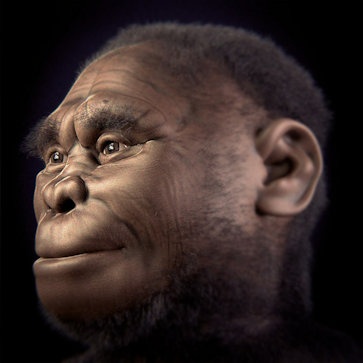
In 2003, a team of Australian and Indonesian archaeologists digging through a limestone cave on a remote Indonesian island were looking for evidence of early human migration. They were not looking for hobbits. They found hobbits anyway.
What emerged from the cave at Liang Bua on the island of Flores was a nearly complete skeleton of a fully grown adult human who stood three feet seven inches tall. She had a brain roughly the size of a grapefruit. She was approximately 30 years old at the time of her death, somewhere between 60,000 and 100,000 years ago. The team nicknamed her “Flo.”
The species she belonged to was formally named Homo floresiensis — Flores Man — but the discoverers immediately reached for a different name. They called them hobbits. Some even lobbied to have the species officially named Homo hobbitus in the scientific literature. Science said no. The nickname stuck anyway.
This is the story of a real creature that shouldn’t exist, on an island that produces things that shouldn’t exist, surrounded by a scientific controversy that still hasn’t fully resolved itself — and haunted by a local legend that may or may not be the oldest eyewitness account in human history.
But before we get there, we need to talk about small people. All kinds. Real ones. Fictional ones. The ones you’ve definitely mixed up. Because the moment scientists called these bones “hobbits,” they walked into a taxonomy of smallness that most people have never properly sorted out — and which turns out to be more complicated, more contested, and more interesting than anyone bothered to explain.
A Brief, Unsolicited Guide to Small People (Real and Invented)
Nobody asked for this. You’re getting it anyway.
Pygmies are real populations of human beings — primarily hunter-gatherers living in tropical rainforests across central Africa, Southeast Asia, and parts of the Americas — defined by science as groups with average adult male height below 155cm (about five foot one). The best known are the Aka, Mbuti, and Efe of central Africa and the Baka of Cameroon. They are fully modern Homo sapiens, not a separate species, not a relic population, not anything exotic. They are people whose ancestors adapted to specific environmental pressures.
The interesting part — and it took geneticists decades to establish this — is that small stature appears to have evolved independently in multiple pygmy populations across different continents, a phenomenon called convergent evolution. The Batwa of Uganda and the Baka of Cameroon are both considered pygmy populations, but when researchers compared their genomes, the genetic roots of their small stature were completely different. Evolution found the same solution in different places through different routes. The leading theories for why small stature was advantageous include requiring fewer calories in food-scarce rainforests, better tolerance of tropical heat, and — most intriguingly — earlier onset of reproduction in high-mortality environments. One study suggested that what looked like selection for small size was actually selection for early reproduction, and small size was just a byproduct. Being short, in this reading, is what happens when dying young is common enough that you need to start having children earlier.
This is a long way from hobbits. Moving on.
Dwarfism is a medical term for a condition — or rather, up to 400 different conditions — resulting in adult height below 4 feet 10 inches. The most common form, achondroplasia, accounts for roughly 70% of cases and involves a mutation on chromosome 4 that disrupts bone growth at the long-bone growth plates, producing the characteristic proportions of a large torso, shortened limbs, and a somewhat larger head. Intelligence and lifespan are normal. It occurs in about 1 in 25,000 births, and notably, most cases are not inherited — the mutation happens spontaneously at conception, which means two average-height parents can have a child with achondroplasia with no family history whatsoever.
The word “midget” — which many people assume is simply a different word for the same thing — is not. Historically it referred to proportionate dwarfism, where all body parts are small in the same ratios rather than the disproportionate limb-shortening of achondroplasia. Today it is considered offensive by most people with dwarfism, traces its popular usage to 19th century carnival freak show terminology, and should be left in the past. The preferred terms are “little person,” “person of short stature,” or, depending on individual preference, “dwarf.” Ask the person.
So: pygmies are a population adaptation. Dwarfism is a medical condition. Neither is the same thing, and neither is what we found on Flores.
The Fantasy Taxonomy (Also Necessary)
Now the invented ones, because the word “hobbit” connects to a whole lineage of fictional small people that are themselves frequently confused with each other.
Tolkien’s hobbits are a distinct invention — roughly 3.5 feet tall, with large hairy feet, a preference for comfort and second breakfast, an ancestral connection to the rural English countryside filtered through Tolkien’s imagination, and zero interest in adventure until plot demands it. They are not dwarves. This is important because Tolkien’s dwarves — the Khazad, the people of Durin, speaking in runes and mining under mountains — are a completely different thing. They’re stocky, bearded, technically shorter than humans but not dramatically so, and descended primarily from Norse mythology’s dvergar, the underground craftsmen who forged Thor’s hammer and built the gods’ treasures. Tolkien’s dwarves are proud, stubborn, skilled, and almost exclusively male in their public presentation, which Tolkien himself once explained by noting that dwarf women are so rarely seen that other races assume they don’t exist.
Tolkien actually used the word “gnomes” early in his legendarium — but not for small underground creatures. He used it as his word for the Noldor, his highest order of elves, derived from the Greek gnōmē meaning “knowledge” or “intelligence.” He eventually dropped the term specifically because traditional gnome mythology — the underground deformed earth-dwelling creatures of European folklore — would confuse readers. He was right to drop it. The gnomes of conventional fantasy are something else: small, often bearded, associated with the earth, tinkering, and mischief, descended from their own separate Germanic and European folklore traditions, and sometimes barely distinguishable from dwarves depending on which fictional universe you’re in. In garden ornament form, they are a Victorian invention that has taken on a life of its own and should be kept away from serious discussion.
Halflings, in Dungeons & Dragons, are Tolkien’s hobbits with the serial numbers filed off due to copyright considerations. They are functionally the same creature under a different name, which is why they’ve always had a slightly apologetic quality — they exist because hobbits couldn’t.
And then there are kender.
Kender exist only in the Dragonlance universe, created by Tracy Hickman and Margaret Weis in 1984, and they are one of the most divisive races in fantasy fiction’s history. They were invented specifically because the Dragonlance designers didn’t want halflings — they felt too much like hobbits, and they were building something distinct. What they built instead was a race of small, wiry, topknotted humanoids standing between three-and-a-half and four feet tall, with pointed ears and a lifespan of around 100 years. Their defining trait is absolute, hardwired fearlessness — not bravery, not the choice to act despite fear, but a genuine neurological inability to feel fear at all. This makes them almost impossible to write convincingly, as Margaret Weis herself admitted. Their secondary defining trait is that they compulsively “borrow” things — pick up objects that interest them, put them in their pouches, and then seem genuinely baffled when the owner wants them back. They do not consider this theft. They are not lying. They simply experience the concept of “mine” and “yours” as unnecessarily rigid.
Game designer John Wick summarized the kender problem in a 2009 podcast: “Kender…they don’t make sense. It doesn’t make sense for a race of sociopathic kleptomaniacs to exist in a culture.” He is not wrong. The kender are fascinating as a concept and legendarily irritating in play — there is a long tradition in tabletop gaming of players who run kender characters as a weapon against the group’s patience. The word “kender” was originally going to be spelled “kinder,” from the German word for children, which reveals the intent more nakedly than the final version does. They are children who never grow out of it, wandering the world with bottomless curiosity and no object permanence regarding other people’s belongings.
Kender do not exist outside Dragonlance. They are not real. We are mentioning them here because they are small and because Tasslehoff Burrfoot deserves acknowledgment. He carried the world on his back and probably put it in his pouch when no one was looking.
Now, Back to the Island That Makes Things Weird
All of the above exists in the context of a species of real small hominins found in a cave in Indonesia that are none of the above and somehow more interesting than all of them combined.
Before you can understand Homo floresiensis, you need to understand Flores, because Flores is not a normal place.
The island sits in the Indonesian archipelago, separated from neighboring islands by deep ocean straits that held even during ice ages when sea levels dropped dramatically. This isolation created one of evolution’s most reliable laboratories: insular dwarfism — the same process driving pygmy stature in modern humans, but taken to a further extreme over much longer timescales and applied to an entirely different ancestral species.
When large animals end up on isolated islands with limited food, few predators, and no competition from mainland relatives, evolution shrinks them. Flores was running this experiment on everything simultaneously. The island was home to a dwarf Stegodon — a prehistoric elephant relative — that had been reduced from the size of an Asian elephant to roughly the size of a large cow. It had giant rats the size of rabbits. It had Komodo dragons, which are what happens when small predators reach islands without large mammalian competition and the process runs in reverse.
So: dwarf elephants. Giant rats. Actual living dragons. And, it appears, three-and-a-half-foot humans who hunted the dwarf elephants with stone tools and may have used fire to cook them.
Flores was doing something to everything that lived on it. Homo floresiensis was simply the most dramatic example.
Who Were They, Actually?
The question of what Homo floresiensis actually is has been argued since the day the bones were announced in 2004.
The leading theory is that they descended from Homo erectus — the upright-walking ancestor that spread across Asia and Africa over a million years ago — or possibly an even more ancient hominin. A population arrived on Flores roughly 1.27 to 1 million years ago, became isolated, and spent the next million years getting smaller. Fifteen individuals’ worth of bones have now been recovered, and the physical evidence for insular dwarfism is considered strong. Their brains were about 400 cubic centimeters — our modern brains run about 1,400.
But what they apparently did with those brains is the uncomfortable part.
Over ten thousand stone artifacts were recovered from the cave alongside the remains — not just basic flakes but points, perforators, blades, and microblades that may have been hafted as weapon barbs. The tools suggest behavioral complexity that seems inconsistent with a brain that small. The conventional wisdom of paleoanthropology had always held that brain size and cognitive capability were tightly correlated. Homo floresiensis appears to be a stress test of that assumption.
They were also, by the evidence of cut marks on bones, hunting dwarf Stegodon — animals considerably larger than themselves. Coordinating that kind of hunt requires planning, communication, and social organization. These were not simple creatures.
The alternative theory — that the remains represented a modern human with microcephaly, a pathological condition producing an unusually small skull — was advanced aggressively by the late Indonesian paleoanthropologist Teuku Jacob, who had himself never published the competing research he implied he had. His response to the discovery was not scientific rebuttal. It was something stranger.
The Bone Theft
In December 2004, Professor Jacob removed most of the original remains from the national research center in Jakarta — with the permission of one director, without the knowledge of the discovery team. He kept them for three months.
When the bones were returned in February 2005, the damage was severe. Deep cuts marked the lower edge of the jawbone on both sides, from a knife used to cut away a rubber mold. A second jaw had its chin snapped off, glued back together, and reset at the wrong angle. The pelvis was smashed. Two leg bones were missing entirely and never returned.
Discovery team leader Mike Morwood’s assessment: “It’s sickening; Jacob was greedy and acted totally irresponsibly.”
Indonesian officials then closed the cave to outside scientists — widely understood as protecting Jacob, who was considered “Indonesia’s king of paleoanthropology,” from being disproven. Scientists were not allowed to return until 2007, shortly after Jacob’s death.
The damaged bones, the missing legs, the misaligned jaw — these remain the primary physical evidence for a species whose existence was actively disputed by the person who mutilated the evidence. Science moved forward anyway. The consensus today treats Homo floresiensis as a genuine separate species. But the original bones still bear the marks of that dispute, which is a more dramatic physical record of academic rivalry than most fields of study ever produce.
The Ebu Gogo Problem
Here is where things get genuinely strange.
The Nage people of central Flores have a legend. They call the creature Ebu Gogo — roughly “old glutton” in the Nage language. The Ebu Gogo, in their oral tradition, were small, hairy cave-dwellers with broad flat faces and wide mouths. They mumbled when they spoke. They were mischievous and sometimes dangerous, known to steal food and occasionally attempt to steal children. They were always outwitted by the smarter, larger humans.
The legend was documented by ethnographers long before the Homo floresiensis discovery. When the bones were announced, the connection was immediately obvious and immediately controversial.
Ethnologist Gregory Forth argued that the legend was oral history — actual human memory, passed down through generations, of real encounters with a real creature. He pointed out that descriptions of Ebu Gogo matched Homo floresiensis closely. He noted that Flores oral tradition placed the Ebu Gogo as present well into the 19th century, with accounts of small hairy cave-dwellers reported into the 1800s.
The scientific response was skeptical, with good reason. The Ebu Gogo legend belongs to the Nage people, whose territory is more than 100 kilometers from the Liang Bua cave — across mountains and dense jungle. The people who actually live near the cave, the Manggarai, have no equivalent legend. Stories of small forest creatures are common across the entire Indonesian archipelago, making any specific connection to Homo floresiensis hard to establish.
And the dating is the real problem. Current evidence places the extinction of Homo floresiensis at approximately 50,000 years ago. For Ebu Gogo legend to be genuine memory of the species, an oral tradition would need to have preserved accurate physical details across fifty millennia. That is a very long time to remember something correctly, even something worth remembering.
Forth maintains there’s something worth investigating. Most scientists consider it interesting but unprovable. The small hairy creatures of Flores folklore remain exactly where folklore always remains — in the space between explanation and imagination.
The Tolkien Estate Weighs In
In October 2012, a scientist in New Zealand preparing a public lecture on Homo floresiensis received a letter from the Tolkien Estate informing him he was not permitted to use the word “hobbit” in promoting the talk. The Estate’s position was that “hobbit” is trademarked intellectual property and that using it in connection with a real prehistoric species constituted unauthorized commercial use.
The scientist noted that the word had already entered scientific literature years before this objection. The lecture happened anyway.
Also in 2012, a low-budget film studio announced a mockbuster called Age of the Hobbits, depicting prehistoric small humans. Warner Bros. sued to block the title. A court ruled “hobbit” was generic enough in the context of the actual fossil species to be permissible. The film was released. Nobody watched it.
The Tolkien Estate’s position is technically defensible and cosmically absurd. The real hobbits predate The Hobbit by approximately a million years. Tolkien described them first; they existed first. He would probably find this delightful.
What They Tell Us About What We Are
Homo floresiensis generates continued argument — beyond the bone theft and the legend and the trademark dispute — because they force a genuinely uncomfortable question about human intelligence.
We have long assumed that big brains are what made us special. Brain expansion over millions of years is the central narrative of human evolution: bigger brain, better tools, more complex behavior, eventually language and fire and civilization. Brain size and behavioral sophistication were supposed to track each other reliably.
Homo floresiensis had a brain a third the size of ours and apparently made sophisticated composite tools, organized group hunts of animals much larger than themselves, and survived for at least a million years on one of the more demanding islands on Earth. If the tool associations are correct — and not everyone accepts they are — then either we have badly underestimated what a small brain can do, or something about the brain’s structure and organization matters more than raw size.
Neither conclusion is entirely comfortable. The first suggests our brain-size exceptionalism may be overstated. The second suggests we don’t fully understand what intelligence is or where it comes from.
They were also, by current evidence, driven to extinction by the arrival of modern humans. We showed up. They disappeared. This is a pattern that repeats across the human story — we are the only hominin species left, and wherever we arrived throughout deep history, the others left or died — and it does not reflect well on us as a genus regardless of specific mechanism.
Are There More?
Possibly.
In 2019, a previously unknown species called Homo luzonensis was announced from the Philippines — also small, also tool-using, also dated to at least 50,000 years ago, also deeply strange. The islands of Southeast Asia, separated by deep water, created isolated evolutionary laboratories running parallel experiments. We have barely looked. The cave at Liang Bua was found by a team searching for something else entirely. There is no particular reason to think we have found everything.
The legends of small forest people extend across the Indonesian archipelago, into the Philippines, through Melanesia. Most folklore about strange things in deep caves on remote islands is just folklore. Most of it.
But Flo was also just folklore, until she wasn’t.
And somewhere out there, in a pouch that nobody authorized, a kender has probably already found the next one.
No responses yet